Material Storytelling Beyond Ends in Marguerite Humeau’s *stirs
Sarah Fredholm
From Nature Future: Three Exhibitions In ARKEN’S Art Axis 2023–25, ARKEN Museum of Contemporary Art & Strandberg Publishing, Copenhagen, DK, 2026
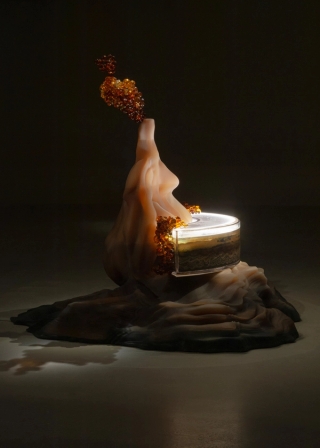
Flickering glass spheres spread across the ceiling of the dim room. Below, a sculpture stands on the floor – a figure, perhaps some kind of guardian, with a luminous, transparent vessel before it. Small, amber-coloured glass spheres rest on top of the vessel, and more appear to sprout from the top of the figure. On closer inspection, the vessel proves to be full of fine layers of sand with green and orange blotches and, at the very top, bubbling water. The figure’s body, made of pigmented rubber, also appears to be composed of layers. From a concealed speaker within the sculpture, sounds stream out: drum rhythms mingle with unearthly, yet almost human song, and bubbling, trickling noises give way to instrumental music. Taken together, all these elements make up Marguerite Humeau’s work *stirs (2024).
*stirs is one of thirteen sculptures and installations in Marguerite Humeau’s exhibition Torches (2025) at ARKEN Museum of Contemporary Art. While most of these works are arranged along the museum’s Art Axis, *stirs is placed slightly apart, at the far end of the exhibition. In the museum’s interpretive text, the work is described as a ‘shared origins’. Even so, Torches is not laid out as a chronological sequence, and there is no fixed route through it – no clear beginning or end. The glowing glass spheres found in *stirs reappear throughout the exhibition, and visitors come across them as soon as they step into the darkened rooms where the works are displayed. In Torches, Humeau’s works interweave like chapters in a larger narrative that seems to point towards other ways of being: here, humanity does not take centre stage but is simply part of a larger, interconnected whole.
Marguerite Humeau describes her own artistic practice as an effort to create ‘new mythologies for our contemporary era’. Her works may be understood as speculative narratives that – in the light of our present-day ecological crises – challenge anthropocentric understandings of the world and open up imaginaries: new, creative scenarios for life on Earth beyond those we know. Taking *stirs as its point of departure, this article will explore these speculative narratives. I wish to draw attention to the alternative, mythological story about a new ‘shared origins’ contained within the work’s unfamiliar, even alien scenario. The article homes in on the narrative devices Humeau’s mythology facilitates, and on the human position the work brings into play.
*stirs is about more than just a representation of the origins of life. The work functions as a sensuous and material storytelling practice that invites the viewer to experience how life unfolds in a continuous process of exchanges that displaces the human from the centre of all things. Focusing on the material and audible dimensions of the work, the article examines how *stirs offers a space for sensing and thinking about the world in new ways – perceiving it as a living ecosystem in which the boundaries between the human and the more-than-human are fluid. The article shows how Humeau’s work articulates care-based and sensuous ways of being connected with the world. The work contains narratives that form urgent responses to the ecological crises of our time – narratives that may help us reorient ourselves in the world.
Challenging and unravelling the notion of humanity being separate from and elevated above the rest of the world has long been a central concern in ecocritical and new materialist theories that seek to rethink the relation between humans and the more-than-human. In this context, the American philosopher and biologist Donna Haraway is one of the most prominent thinkers. She points out how we, as humans, are always already entangled with other forms of life, and she emphasises how the stories we tell about the world shape the ways in which we understand it and act within it. Haraway’s thinking is brought into play here because it offers a useful lens for considering Humeau’s works, which specifically imagine various scenarios for our relationship with the more-than-human and pave the way for alternative narratives for us to explore as responses to our present day.
While Haraway offers a perspective that can help illuminate the work’s narrative form and its potential, the political theorist and philosopher Jane Bennett’s new materialist conceptual framework brings a heightened attentiveness to the agency of matter itself within the work. In Vibrant Matter: Political Ecology of Things (2009), Bennett reconsiders human relationships to the surrounding world and argues that all material entities possess a vital force – a capacity to act, to affect and to produce effects. Her thinking enables us to read Humeau’s work not simply as an image of the origins of life, but as a work in which the materials emerge as active co-creators. These two related yet distinct perspectives form the theoretical framework of the article: Haraway contributes a lens for the speculative and narrative aspects of *stirs, while Bennett facilitates a reading of the work’s material and sensuous agency. Together, they make it possible to examine how myth and matter, narrative and substance, are woven together and operate in Humeau’s *stirs.
The article takes its point of departure in a close reading of *stirs, in which the work’s title, form and sensuous aspects are seen as mutually interconnected. The reading then moves on to a theoretical investigation of how narrative and materiality interact in the piece. Supplementary perspectives – the American mythologist Joseph Campbell’s reflections on the form of myth and the sound theorist Salomé Voegelin’s investigation of sonic perception – are brought in to nuance the mythical, tactile and auditory dimensions of *stirs.
Layers and Origins
In *stirs, Marguerite Humeau unfolds a story of a ‘shared origins’, not as a single narrative, but as a sensuous and material process in which life arises, dissolves and is reconstituted in the work’s rhythms and connections. The question is what kind of myth of our present takes shape here – and how.
The title *stirs offers a hint about the work’s narrative principle. The word refers both to ‘stere’, which in Proto-Indo-European means ‘to spread’ or ‘stretch out’, and to the Ancient Greek ‘strôma’, which means ‘layer’. This duality points towards both movement and stratification – and thus the work’s narrative is tied to rhythmic processes as well as accumulations.
In conceiving *stirs Humeau was inspired by stromatolites – fossil microbial mats that are among the earliest traces of life on Earth. They formed in layers of cyanobacteria in step with the tides around 3.5 billion years ago. With *stirs, Humeau invokes the cyclical processes of stromatolites as an image of the shared origin of all forms of life. Their movements are echoed in the deposits inside the work’s vessel: a small ecosystem consisting of layers of sand, water, bacteria and micro-organisms that continuously grow, decay and transform. The ecosystem mimics the emergence of the very earliest life forms. In this way, the narrative of a ‘primal origins’ is part of the work’s very materiality – a place where different temporalities meet and are negotiated.
The title’s suggestion of movement announces that the beginning in *stirs is not a single point in time, but a generative process – a cycle in which life arises, dissolves and begins anew. One might imagine that the life contained in the vessel has bubbled over, causing the glass spheres to spread like bubbles or cells from the wellspring of life below. They can be understood as micro-universes or seeds of new worlds, germinating as they spread throughout the exhibition. The figure in the work can be seen as a guardian of the ecosystem’s nascent life. With its layers, it seems simultaneously to watch over the processes in the vessel and to be formed by them, as if the figure had itself sprung from the ecosystem’s deposits, as if it is kin to the microscopic life forms that grow within it, as well as to the layers of stromatolites underpinning the work. The guardian appears at once human-like and geological: it has something resembling a body and a head, combined with a stratified structure of the stone. Made of pigmented rubber, the hybrid guardian appears soft and malleable, yet at the same time firmly anchored in the space and in the glass spheres it helps set in motion.
Moreover, the asterisk in *stirs can be seen to suggest that the work might be regarded as a footnote. The work points beyond itself and continues in other stories. There is something paradoxical to this gesture, staging a beginning while also functioning as a footnote. This duality underscores the work’s open and non-linear narrative form. The little star reminds us that *stirs does not contain a single, all-encompassing story of origin, but rather holds many beginnings that unfold throughout the exhibition.
Speculative Narratives without a Centre
In *stirs the story of the origins of life is staged as an open exchange rather than as a linear creation narrative. This open narrative form can be understood in light of Donna Haraway’s concept of ‘speculative fabulation’ – a storytelling practice that sustains complexity rather than seeking resolution. For Haraway, this is not only a matter of imagining other worlds, but also of forging relations between the human and the more-than-human across times and materials. ‘Speculative fabulation’ is both theoretical and sensuous in nature, a way of thinking and acting that combines science, facts and fiction to nurture new forms of co-existence. Storytelling is, for Haraway, not a neutral tool for describing the world, but a situated practice for making connections: ‘It matters what stories make worlds, what worlds make stories’, as she puts it.
This is pertinent to Humeau’s *stirs, which can indeed be read as a way of thinking and sensing with the world rather than merely as a representation. It can be read as a myth in which forms of life and materiality interweave in a dynamic cycle. Across time and place, from a distant prehistory to the space of the exhibition, the elements of this artwork engage in mutual relationships with each other. Haraway’s ‘speculative fabulation’ resonates with Humeau’s practice in that she strives to interweave scientific facts with speculation and sensuous materiality. This is also the case in *stirs, where the references to stromatolites, the ecosystem and the work’s many and varied physical components merge into a larger whole. The staging of life’s primal origins becomes a retelling of a creation myth that does not establish hierarchies or separations, instead creating conditions for co-existence and mutual obligation across species and times. Seen through the lens of Haraway’s thinking, the work can be regarded as a practice that forges connections and provides fertile ground for new ways of being in the world.
What is more, in *stirs life also appears to be shaped through collective effort rather than by a single creative agency. The guardian is not a divine or heroic figure, but the result of the very processes it watches over. The organic forms of the glass spheres, the bubbling contents of the vessel and the figure’s body are all part of the same rhythmic system: a collective, processual form of creation within a network of relations. This can be read as what Haraway terms ‘sympoiesis’, a shared co-creation enacted within complex, situated systems. Such creation, becoming and thinking-with the Earth’s many species constitutes a marked contrast to the notion that something or someone stands outside, governing the world. In *stirs the beginning of life appears as a movement that arises and takes shape in the interaction between the work’s elements, organisms and materials, rather than occurring through the intervention of some creative authority that forms the world from outside, at a distance.
Myths without Heroes
In contrast to the grand cosmogonic narratives that shape Western thought – from the Biblical creation story to the evolutionary accounts of the natural sciences – *stirs, as mentioned earlier, does not posit a single point of origin, and the human being does not occupy a central place in the work. Its narrative also differs from the heroic myths Joseph Campbell describes in The Hero with a Thousand Faces (2008). Here Campbell identifies a monomythic structure which he believes cuts across cultures: the story of the hero who is separated from their world, undergoes trials and returns with renewed insight. For Campbell, hero myths and cosmogonic tales both reflect the human being’s inner journey and psychological development. These mythic trajectories rest on an anthropocentric and teleological logic in which a creative agent drives the story towards resolution. In Humeau’s origin myth, we find instead a weave of beginnings and transformations that continue in an ongoing cycle of life. The work does not revolve around a central protagonist to whom all other stories are subordinated. Rather, the centre of the narrative shifts between the work’s elements and their mutual relations – and between the many voices of the exhibition: the rhythmic interplay found in Torches as the sounds from the works by turn swell and fall silent like a collective breathing, underscores the cyclical structure in which more-than-human relations are interwoven in a larger whole without any clear ending. In classical hero and creation myths, Campbell identifies a cyclical structure which he calls ‘the cosmogonic cycle’, encompassing a movement from birth through death and rebirth to new insight and redemption. But whereas this structure points towards unity and closure, *stirs dwells instead on the ongoing cycle of becoming, a cycle without telos in which transformation does not lead to revelation and insight. In this way, *stirs can be read as an effort to shift the mythical basic structure, moving from an anthropocentric paradigm to an open, polyphonic and non-heroic form in which the movement of life is sustained by relations and material reciprocity within a more-than-human field.
*stirs can thus be said to create new narrative strategies that make it possible to envision human being-in-the-world through connections rather than through dominating the surrounding world. Such stories, Haraway reminds us, can improve our ability to act responsibly in and towards the world: ‘Why tell stories like this, when there are only more openings and no bottom lines? Because there are quite definite response-abilites that are strengthened in such stories.’ For Haraway, narratives that point towards ongoing relations rather than promising final resolutions and redemption are crucial because they enhance our capacities to care for a shared world. We must, she argues, pursue stories that foster unexpected configurations of species, places, times and materials. She insists that we must ‘stay with the trouble’ – stay with the difficult time we are in, in which we humans are entangled with other forms of life.
The open-ended narrative in *stirs can give rise to a sensuous experience of being part of a larger, unfinished cycle of life. This can be felt in the encounter with the work’s rhythmic interplay of light, sound and materiality, which places the viewer within a more-than-human field: in the layers of the ecosystem where bacteria slowly form, transform and break down life, in the figure’s hybrid state between human and geological matter, and in the amber glass spheres that spread out through the exhibition like cells or new beginnings. In *stirs the movement of life has no central agent; it emerges out of connections between materials, voices and rhythms that pulse in union with the exhibition’s other works. Here life arises between the elements of the work – its origin is not a singular event. In the exhibition space this is sensed as a movement that does not revolve around one single figure or centre. Rather, the processes of life are distributed among the microscopic life of the bubbling vessel, the figure’s layered, almost sedimentary body and the scattered flashes of the glass spheres in the ceiling. The rhythmic exchange between the work’s elements means that none of them appears as the driving force. Instead, they jointly form a cyclical, shared narrative that draws the viewer in. In this way, the work invites us to care for and tend the world as a shared, living network. Here we find no idealised notions of an original state, nor any teleological movement towards an ending. What might look like a mythical moment of creation becomes instead an image of unceasing processes – a polyphonic mythology in which time, matter and life forms are integrated into an open narrative without fixed endpoints.
Materialisations
As noted above, in *stirs the story of a ‘shared origins’ is part of the work’s materiality; it is embedded in the ecosystem’s microbial cycle which re-enacts the slow movements of the stromatolites and propagates through the rest of the work. In her practice, Humeau has developed an experimental approach to materials – ranging from smooth, machine-produced surfaces to a tactile, almost alchemical handling of elements such as hand-blown glass, cyanobacteria, beeswax, alabaster, wasp venom and yeast. This composite use of materials gives *stirs a powerful material presence.
Drawing on Jane Bennett’s new materialist understanding of the agency and vitality of matter, we can look more closely at the material properties of *stirs and at how the tactility of the work itself seems to participate in its narrative: the deposits of the ecosystem with coloured, living zones, the hand-blown glass spheres with biological and synthetic filaments that glow and flicker across the ceiling and lend the piece its rhythm, and the malleability of the rubber, which contributes to the hybrid character of the figure. The elements of the work act upon one another; the shifting colours of the micro-organisms give the vessel its appearance, and the bubbles in the water gather as air pockets at its top. The fragility of the glass spheres accompanies the porosity of the rubber, and the warm light of the glass in the dark endows the whole with rhythm and a charged atmosphere.
The juxtapositions of materialities and their interrelations in the work can be read as what Bennett calls ‘assemblage’: an interplay of organic and inorganic elements, human and non-human forces, in which no central agency governs the whole and meaning arises in the encounter between materials. Seen through Bennett’s lens, the materiality of *stirs appears not merely as a means but as a co-creative force in the work’s narrative, partly because the narrative of cyclical movements and complex beginnings is embedded in the work itself, and partly because the materials come across as having agency. The thematic, formal and material dimensions of *stirs emerge as a coherent field – an ‘assemblage’ in Bennett’s sense, in which meaning and life arise in the encounter between materials.
The soundtrack of the work intensifies its tactile qualities. The changing, mutable sounds – pulsing rhythms, unfamiliar vocal timbres and organic, rippling noises – which seem to stream from the sculpture’s interior are not merely atmospheric background; they form a rhythmic pulse that connects and synchronises the material elements of the work. Building on Bennett’s ideas, the sound aspects of *stirs can be understood as an active force within the assemblage, binding the components together in a shared rhythm. In this regard, Salomé Voegelin offers a perspective that can further nuance this reading. In Uncurating Sound (2023) Voegelin argues for a relational approach in which sound paves the way for perceiving the world through relations rather than through representation. Listening, according to Voegelin, is a physical, bodily practice that draws the listener into a field of resonance. Writing about Humeau’s spoken-word Weeds (2021), she highlights how, in this work, sound creates connections between bodies, voices and stories rather than referring to fixed meanings. As Voegelin puts it: ‘The sonic […] refuses distance, it touches my skin.’ She thus underlines that sound is not something we experience at a remove; we are enveloped by it and become part of it. Sound can blur the boundaries between work and surroundings and alter the relation between human listening and more-than-human resonance.
On this basis, *stirs can be read as a sonic-material field in which the relations between material components, voices, tones and rhythms render the processes and interconnections of life sensuous – not as a closed-off, finite representation, but as an open, co-creative practice in which the viewer is entangled. While Bennett’s perspective draws attention to the inherent material agency of the work, Voegelin’s insights show how this agency can be sensed and understood through a participatory listening – in a sonic-material field that both binds and envelops the listener. The strange tones in *stirs can evoke a sensory experience of being woven into a dynamic field in which the distinction between the human and the more-than-human is being negotiated.
Human Displacements
In her thinking, Bennett dissolves the sharp divide between human and world, between culture and nature, in favour of a continuum in which a reciprocal exchange between body and matter takes place. The boundaries between human and materiality thus become fluid – a movement that can also be traced in the figure in *stirs. The figure appears hybrid and without any real leading role in the work’s narrative. It seems simultaneously human-like and geological, a suggestion of a body and a head combined with the stratified structure of stone. Although the figure does not appear unequivocally human, it leaves – alongside the voices in the work’s sonic layer – a trace of something recognisable, an echo of human presence. But what place, then, is accorded to the human in Humeau’s *stirs?
Bennett writes of how ‘a touch of anthropomorphism […] can catalyze a sensibility that finds a world filled not with ontologically distinct categories of beings (subjects and objects) but with variously composed materialities that form confederations.’ She proposes a strategic anthropomorphism – not in order to humanise things, but to make our senses receptive to the vitality of things and thereby clear a path towards the more-than-human. This path must, according to Bennett, be taken through likenesses across differences and thus also via anthropomorphic traits. In *stirs the hint of human qualities in the figure can serve a similar function: it draws us in, yet at the same time causes a shift in our gaze. This displacement – where something alien is sensed within the familiar – can, in Bennett’s terms, foster a more responsive and sensing position in the world.
The work does not deny the human being, but rewrites its position – bringing it into play as part of a wider exchange between species, materials and forces. In the interweaving of human-like traits, microbial and geological matter, glass, rubber and pigment, *stirs does not point towards the erasure of the human, but towards kinship – a commonality across species and materialities in which the boundaries between body and surroundings are open to negotiation. What would otherwise be understood as alien and non-human is given a voice: the materials, the figure and all the elements of the work, together with the resonance of the sound, enter into a shared circuit of which the viewer also becomes a part.
From here, *stirs opens onto a sensuous myth without a clear beginning or ending. The ongoing becoming of life pulses within the work and outwards into Torches. Here the world is not something we contemplate from a distance – we are woven into it. In Marguerite Humeau’s world, the role of the human being is not to rule, but to take part, to take care. In *stirs the mythical narrative becomes a living substance – an open, polyphonic fabulation. By shifting the mythical basic structure, Humeau shows how fabulation, sensing and accountability can be connected in new, caring practices – in a story that does not seek redemption, but a continued, shared presence in the world.
Sarah Fredholm is an art historian and a curator at ARKEN Museum of Contemporary Art since 2022. She most recently curated Torches – Marguerite Humeau (2025).
.jpg?w=320&q=100&auto=format)
_2023_Image_credit_©_White_Cube_(David_Westwood).jpg?w=320&q=100&auto=format)
.jpg?w=320&q=100&auto=format)
.jpg?w=320&q=100&auto=format)
.jpg?w=320&q=100&auto=format)