Who Knows...
Rebecca Lamarche-Vadel
From FOXP2, Marguerite Humeau, Les presses du réel/Nottingham Contemporary, Dijon/Nottingham, FR/UK, 2016
“Marguerite Humeau: What are the trigger events that allow a being to become conscious? What might be the tipping points? Carl Safina: No one knows the answer to that question …”(1)
Marguerite Humeau speculates about the way mankind can now, thanks to technological progress, succeed in creating and experiencing supernatural phenomena (listening to Cleopatra’s voice, hearing an opera of prehistoric creatures, reproducing the birth of love), whose causes and consequences are unknown scientifically and which gives rise to invisible powers. Right from the start of her investigations, she refused to accept the idea of a separation between the objective and the subjective, and has constructed a universe in which reality is formed like a palimpsest, where logical thought has liberated itself from its deafness to dreams. The Black Rainbow (2) is the title the artist gave to her 2010 research thesis, at the conclusion of her education at the Royal College of Art in London, where she was doing an MA in Design Interactions. The idea was then for the artist to study the evolution of our relationship to the sublime, which she genealogically associates with our relation-ship to the supernatural. Romantic artists, from Caspar David Friedrich to J.M.W. Turner, were already feeding on sensations set off by nature’s more violent displays and this feeling expressed their mystical vision of the world.
It is customary to present Western modernity as a movement that developed in a state of utter impermeability to the inexplicable and the unexplained. Since the Renaissance and the Enlightenment, our thought has supposedly turned towards the doctrine of positivism (3), while technological progress has allowed humanity to pass from a primitive state to civilisation, with Descartes declaring that he would make us like “masters and possessors of nature”(4). Mankind could then view the surrounding environment with a scientific gaze, while knowledge would provide a control of the natural world, which had been conquered by the exercise of reason and an “objective” approach. Humeau, sceptical about any unilateral reading of history, has inspected modern writings about knowledge and observed in them a permanent form of mysticism; “I started to investigate the correlations that exist between supernatural events and communication technologies. There are actually strong links between the two, as Jeffrey Sconce explains in Haunted Media (2000). For example, Alexander Graham Bell invented the telephone because he had promised his brother that, when one of them died, they would find a way to communicate together. … Similarly, after Morse invented the telegraph in 1848, the Fox sisters in New York started to create systems that they called ‘celestial telegraphy’, in order to communicate with a ghost that was haunting their house. The disembodied voice in itself could be considered as supernatural, although we are now used to speaking to voices with our communication devices.”(5)
The Anthropocene (6), one possible starting point of which lies at the explosion of the first atomic bomb on 16 July 1945 in New Mexico (7), was born at the moment when mankind, thanks to scientific progress, rained down death from the sky, thus taking possession of a space that had long been reserved to higher forces (gods, climatic elements, the universe, etc.). This geological epoch, into which we may now have entered, reactivates the imagery of collapse, and the aesthetics of extinction – feelings close to the sublime – while we advance into a period during which mankind, as both earth’s hero and villain, needs to rethink its connection with nature and the way it situates itself in the world. “Popular responses to these challenges track in two directions. The first and most prevalent encourages more modernisation; a final escalation of human domination, with Man as the ‘God Species’ able to fully domesticate our unruly planet and its lifeforms. Better markets, new technology and rational administration are the prescription. The second advocates retreat; a return to Nature through a disavowal of any or all of the above forms of modernity. Its most misanthropic incarnations offer a world without us.”(8)
Humeau positions herself at the crossroads between these two hypotheses, offering through her work a “multinatural”(9) vision, in which mankind, which is no longer the world’s pivotal axis, is evolving amid multiple milieus, which can be human, non-human, biological, technological or electric, cohabiting on a planet where their forces are bound together. When Humeau asked the professor Carl Safina what might change about our relationship with the world, if we no longer view it through a human prism, he replied: “It can help us understand that the world is not designed for us, that we are not the centre or measure of everything, that life is not about us, and not about now. The living world is greater and older and will last longer than us.”(10)
Fascinated by the way in which mankind rewrites its relationship with reality (wavering between an attraction to, and a rejection of, invisible forces), Humeau has embarked on vast odysseys, during which she exhumes everything that we can know about ourselves as eternal prisoners of a relationship with the world, which is determined as much by sentiment as by proof. Her various projects address myths of origins, to which it is impossible for us to give any definitive answers; how and when was consciousness born? What were the first words? What is the origin of love?
The exhibition FOXP2, presented at the Palais de Tokyo and Nottingham Contemporary, considers consciousness, its origin, and the possibility of reproducing it on an industrial scale. For centuries, mankind has been trying to understand the nature of consciousness. Can it be explained mechanistically? Do non-human forms of consciousness exist? How could these be recognised? What is the relationship between consciousness and language? What events lead beings to become conscious? In 2001, a study discovered that the gene FOXP2 seems to have acted on our aptitude to acquire articulate language. However, nothing has yet allowed us to understand why this mutation, which occurred between 200,000 and 100,000 years ago and led to the descent of the larynx, happened to humans rather than to other species, given that this gene is present in all animals.
Intrigued by this phenomenon that occurred at a microscopic level, but whose consequences have been monumental in human evolution, Humeau set off on a speculative exploration into origins of consciousness and language. The consequence of this has been to create a contemporary myth; “We’re already creating our own myth; we don’t know what the source is. The question of the source is an interesting one, as we all check Wikipedia and assume this is the truth. With the Prehistoric Creatures project, I was researching real things, then I had to add gentle amounts of fiction because there were gaps in the knowledge. It is interesting to embrace the possibility of creating a myth. I’m generally interested in topics that are hidden or difficult to research – it’s about speculation and creating a new story. Myth has always been used to understand the nature of humanity.”(11) The hypothesis adopted by Humeau proceeds from a deliberate choice she has made between the multiple other possible answers to the mysteries of humanity. Our very inability to get back to these origins thus provides her with an infinite field of speculation.
With FOXP2, Humeau has invented an alternative odyssey to the Anthropocene, which she has called “Probocene”. In it, elephants, rather than humans, have evolved as the dominant species, which the mutation of the FOXP2 gene has endowed with language. During the construction of her project, the artist gathered all of the available information about her research subject, by collecting scientific data and expert opinions from zoologists, palaeontologists, biologists, psychologists, theorists and linguists (12). In this way, the artist has become the creator, oracle and guide during this journey into another possible world, while filling in the silences of science and knowledge with her own creations. Each piece was born from some inaccessible, or lost, piece of information, while bringing back to life an extinct or hidden world. Her research feeds off the idea of extinction and the impossibility of speaking about things we can never really know or experience. “It always starts with a mystery. My research process is for me a bit like a performance; I become a heroine on a quest to resurrect prehistoric creatures, to communicate with alien beings, to revive extinct languages from Cleopatra’s times…like an Indiana Jones in Google times.”(13) The work becomes the catalyst of a dream: “to create enigmas instead of solving them … the enigma would then become unsolvable, the mystery filled with contradictions and paradoxes.”(14)
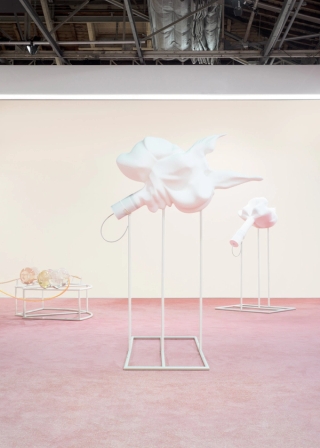
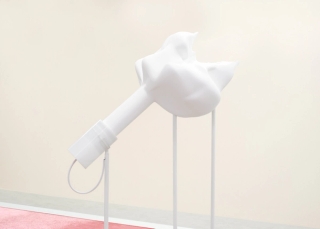
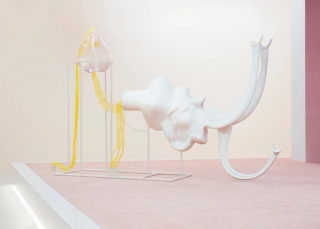
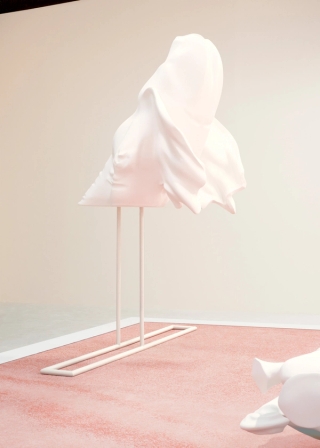
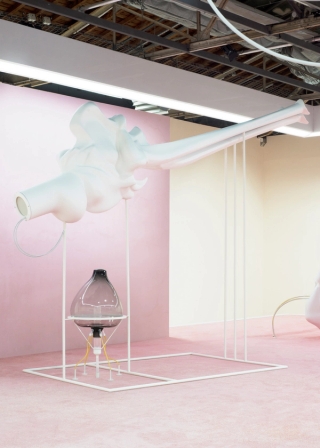
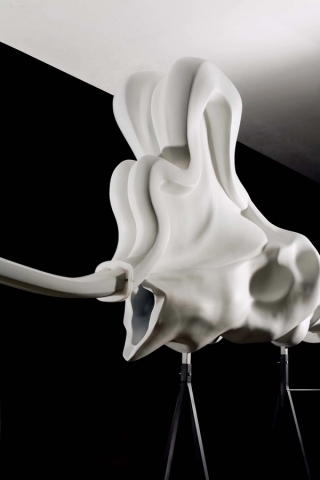
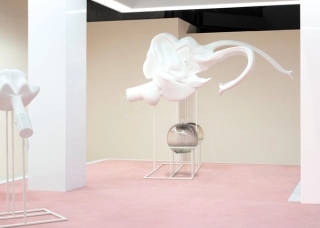
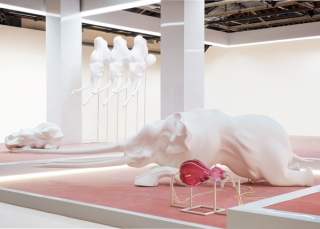
This new history of the birth of sentience, this alternative hypothesis offered by Humeau in the exhibition FOXP2 is based around a central installation: The Birth of Consciousness (2016). Experts were invited by the artist to speculate about the possible evolution of elephants in the Probocene epoch. Pachyderms would likely develop larger brains and slimmer bodies, while their tusks would evolve into horns, with sensory feelers at their tips. In her sculptures, Humeau gives life and form to these hypotheses. The Birth of Consciousness is inspired by a funeral ritual performed by certain elephants, which has been observed, among others, by the biologist Anthony Hall-Martin in South Africa (15). The group’s matriarch, Echo, moves around the centre of the space, in her protracted death throes. This animal has been conceived to die, equipped with an artificial glass heart and filled with a liquid that gradually kills her. This artificially programmed death stands as the decisive moment in this group of elephants’ accession to consciousness. Each of them has been programmed to be gripped by an emotion, while also being reduced to a purely biological function, or a certain form of sentience. Three elephants, Edwina, Amelia and Antonia, whose larynxes have moved downwards after a mutation of the FOXP2 gene, develop a primitive language, which begins to sketch out a rhythm. Félicie, nourished with ethanol, is in an altered state close to drunkenness and adopts a self-destructive behaviour. Meanwhile, Tony receives an injection of despair hormones. Further off, two other elephants, Vronski and Deborah have been conceived to fall in love and are fed with hormones (which are constantly injected), thus reproducing the three successive stages of love: attraction, sexual desire and attachment. At the same time, the calf Bastien is being born. Jean watches the scene, developing a sensation of amazement and contemplation. Pierre is being fed with hormones of happiness, while Emmett is a male being nourished by a dark liquid: “musth”, a thick secretion that emerges from the cheeks of rutting elephants. Enid receives an injection of hormones associated with sadness.
The platform where these elephants’ conscience arises is covered with a monumental carpet, Body Without Soul, Liquid Human (2016), whose threads have been dyed with all the chemical components of a human being (oxygen, carbon, etc.) used as pigments. This human body has been poisoned by powdered Datura seeds, a plant whose berries is thought to be the forbidden fruit mentioned in Genesis (16). Elephants are now born as conscious beings with, at their feet, a humanity reduced to its liquid state, or a soulless bodily form.
“I’d like people to wonder if what they are seeing is real.”(17) Humeau works like a filmmaker, following a scenario in which she rearranges the visible, while orchestrating the life and death of seemingly fantastical creatures. Her practice proceeds from what seems to be an extremely legitimate postulate; the universe and its disposition result from our world view, between experience and belief, the tangible and the invisible. This universe reminds us of the works of David Cronenberg, Matthew Barney or Apichatpong Weerasethakul, filmmakers whose movies mingle myths, beliefs, ghosts, creatures, science and dreams, in the same space and the same time. The exhibition FOXP2 has been conceived as a showroom, a space linked to the cult of the object in our industrial society, in which manufacturers can deploy the universe of their brands and where the fiction that results from this manifestation is played out. This showroom has been plunged into a light described by the artist as being a “luminous horror”, a paradox coming from intense brilliance, which dazzles us and prevents us from seeing. This blinding space evokes the “technological sublime”; that second nature which has been created by mankind and which is being instilled and imposed in the “natural” world. The artist’s high definition sculptures are like spectres, apparitions to which she brings an ultimate form of precision, so as to “virtually make them vanish”.
These pieces, embodying the elephants’ transformation process, are accompanied by a virtual choir, made up of the 108 billion Homo sapiens who have lived since the dawn of humanity, and who guide the elephants along their accession to consciousness. This choir has been developed by Humeau in collaboration with Pierre Lanchantin, a researcher at the Machine Intelligence Laboratory, at the University of Cambridge. It is reminiscent of the sonic research conducted by Gil Joseph Wolman, in particular his Mégapneumes (1950), sound poems with breathing instead of letters, in which the resources of his body can be heard panting to the point of exhaustion. The ambition of Wolman’s poetry is to produce a “synthetic death” through breathing, while Humeau aims at creating a “synthetic presence”. For the visitors, the choir evokes the ghosts of humanity, the mystery of its origins and the struggle of mankind to become mankind. What can be heard is the progression of a 100,000-year-old voice, firstly imitating the rain, the wind and the birds, attempting to speak without managing to, choking, then mutating thanks to FOXP2. A hundred and eight billion human voices sing in a chorus, speaking an incomprehensible proto-language, to the point of saturation. What can be heard are the souls of all the human beings who have peopled the planet since the birth of the first tribes of Homo sapiens, thus corresponding to Marguerite Humeau’s fascination for invoking our spectres: “I was interested in how the voice can actually bring a being physically back to life.”(18)
Humeau dives into the paradoxes and contradictions of the knowledge constructed by mankind so as to recount its nature. She draws close to the source of great enigmas, layer by layer, crossing the sedimentation of discourses, though without ever claiming to provide answers. These mysteries of humanity, and the millennial attempts to grasp the tumultuous connection between mankind and the world, find neither definitive resolution nor rest. The point then is perhaps to accept the implausibility of our condition, the supernatural aspect of our presence, when we confront the impossibility of giving an ultimate answer to the justification of humanity’s existence. “Thus, the contemporary is no longer the one who wants to be of his time, to belong to his time, to be the present, but more the one who hopes to be more present than the present: to not be eternally subjected to variation but to be eternally the variation; he no longer wants to be merely living, but to be life, and replace evolution.”(19)
References
- Extract from a conversation between Marguerite Humeau and Carl Safina reproduced in this book, see page 83.
- Marguerite Humeau, Space, Sublime and Spectacle: The Black Rainbow, research thesis, MA Design Interactions at the Royal College of Art (London), 2010.
- One of the great foundation texts of the positivist doctrine is Auguste Comte’s A General View of Positivism.Published in 1848, this manifesto defended the systematic recourse to feelings and actions and aimed at scientifically organising politics, morality and religion.
- René Descartes, Discourse on Method (1637), Part VI.
- Extract from an interview between Marguerite Humeau and Allison Hugill, Berlin Art Link, 3 May 2015 (http://www.berlinartlink.com/2015/05/03/interview-marguerite-humeau-communicating-with-the-creaturely).
- In 2002, Paul Crutzen, coined the term “Anthropocene”. Aneologism associating the Greek words for “mankind”and “recent”, this term means that human activity is now the main force governing planetary evolution, and that industrial capitalism is henceforth linked to the Earth’s system.
- The starting date of the Anthropocene epoch is still a question for debate in the scientific community, see forexample:http://www.nature.com/news/first-atomic-blast-proposed-as-start-of-anthropocene-1.16739.
- Text from the presentation of an interdisciplinary research seminar entitled Life after the Anthropocene, organised by Jamie Lorimer and Jamie Castell and held at the Oxford Research Centre in the Humanities (TORCH) in 2014-2015. See http://www.torch.ox.ac.uk/anthropocene.
- The term “multinatural” was coined in the book Cannibal Metaphysics (Minneapolis, MN:Univocal, 2014), in which Eduardo Viveiros de Castro dives into the heart of Amerindian thought, so as to escape from an anthropocentric perspective of the world. For Indians, it is out of the question to deny individual existence to anyone/thing, given the fact that this is the very precondition for everything that exists in the cosmos, or to see them as occupying the place of a person or a subject, or to distinguish humanity as a species. Instead, the world is inhabited by a set of human and non-human subjects, which can be distinguished by different viewpoints corresponding to their ways of being.
- Extract from a conversation between Marguerite Humeau and Carl Safina, reproduced in this book, see page 83.
- Extract from an interview between Marguerite Humeau and Agnes Gryczkowska: “Enter a room full of black mamba venom with Marguerite Humeau”, Sleek, n.d. (http://www.sleek-mag.com/2015/05/04/marguerite-humeau-duve-berlin/).
- See the conversations of Marguerite Humeau with Carl Safina and Bernard Buigues, reproduced in this book,see pages 83 and 87.
- Extract from an interview between Marguerite Humeau and Allison Hugill, BerlinArtLink,March2015.
- Extract from an interview between Marguerite Humeau and Eva Folks, AQNB, September 2015 (http://www.aqnb.com/2015/09/07/an-interview-with-marguerite-humeau).
- Martin Meredith, Elephant Destiny: Biography of an Endangered Species in Africa, (New York, NY: PublicAffairs,2004),184-186.
- “High Art: Were Botticelli’s Venus And Mars Stoned?”, npr.org, June 2010 (http://www.npr.org/templates/story/story.php?storyId=127752216).
- Extract from a conversation between Marguerite Humeau and Rebecca Lamarche-Vadel, May 2016, Paris.
Translated by Ian Monk
Rebecca Lamarche-Vadel is a curator at the Palais de Tokyo. She curated Marguerite Humeau’s solo show at the Palais de Tokyo and Nottingham Contemporary.

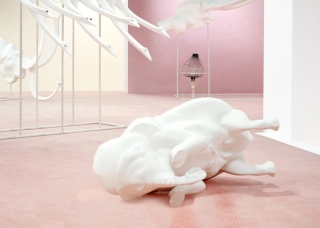
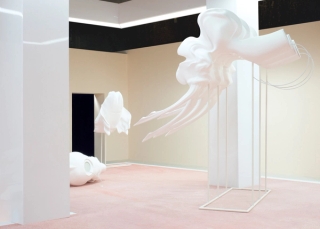
_Two_elephants_engineered_to_romantically_fall_in_love_with_each_other_2016_Image_credit_Spassky_Fischer_Courtesy_the_artist_C_L_E_A_R_I_N_G_New.jpg?w=320&q=100&auto=format)