Terraforming on Earth
Esther Leslie
From Auguries, White Cube, London, UK, 2025
Method in meys and Orisons
‘Terraforming’ (literally, ‘Earth-forming’) is a process dreamt up in science fiction, though it has now entered the vocabulary and practice of tech billionaires with ambitions to sustain human life on Mars. It involves augmenting off-planet atmospheres, temperatures, surface topographies and environments so that they become more Earth-like and, therefore, habitable for humans. Remarkable in Marguerite Humeau’s ‘meys’ (2023) and ‘Orisons’ (2023) is that it proposes a kind of terraforming that, rather than being off-planet, happens here, on our increasingly uninhabitable Earth. Through these works, new geographies and geometries are installed. Different techniques and perspectives – those borrowed from the worlds of parascience or ritual – elicit strange (because unfamiliar) accords between species, or refract what it means to be intelligent, sensitive and sensing, or plumb deep and parallel times and conceive space as multiple strata.
There is the proposition of learning from other life forms, especially those that have found ways of living beneficially in collectives. Threads and ties between environment and life are brought into focus – mutual aspects in coexistence – and allowed to thrive. Focus is what art may donate to an idea as much as to an object. In the case of ‘meys’ and ‘Orisons’, focus refers to the networks, lattices and grids (some invisible outside the art context), that are brought to light. It refers to an attuned listening – perhaps to landscape, to the sound of wind or human breath as they pass through metal. ‘meys’ and ‘Orisons’ meddle with the apparent stability of this world to expose – to a listening ear, an attentive gaze – occluded aspects, horizons beyond the horizon, a ferment that sizzles in the background. Humeau’s artworks are guides to both a ‘there’ and to a ‘somewhere else’.
Orisons: Theurgy
If the word ‘horizons’ is indicated in the title ‘Orisons’, it directs attention to the vastness of the tract of land involved in this particular artwork, and a location framed by its literal and metaphorical horizons. As I began to think about the work, I remembered a book sat dormant on my shelf: Iain Sinclair’s Edge of the Orison.1 I rifled through it to find out more about the unusual word both Sinclair and Humeau had chosen. The book is a mediation on the 19th-century poet John Clare, and on the depredations of early-21st-century Middle England. In 1841, Clare escaped from a mental asylum in Epping (near London), and started to walk towards his home, some 80 miles away in Northborough. Clare was returning, he hoped, to his lover, unaware that she was already some three years dead. To orient himself homewards, he lay down at night with his head always pointing North, like a compass. He headed each morning for the horizon, so that he might return to a place he knew and that knew him – an enclosure of his own making, rather than those being imposed on the landscape of England at that time, and against which he railed. Clare, a poor poet, barely schooled, spelt horizon ‘orison’. The word is only one letter different from ‘prison’ – Clare had exchanged prison for an orison. This diversion took me no nearer the meaning of the word, but did open out onto this other, American landscape with its enclosures, its disorientations and its grasses (the like of which a hallucinating John Clare ate in England, starving, by the roadside).
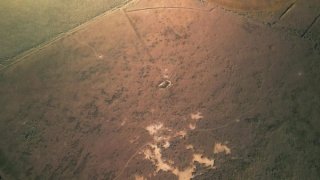
There are bones on the site marked out for Humeau’s ‘Orisons’; ribs and femurs sink, even as they splay. These bones – bleached by sunlight, eroded by whipped-up sand, weathered by wind – were photographed for the artist’s project materials. A caption speculated, ‘How it would feel, to die alone, in the desert.’ What would it be like to die alone as an animal in this scrubland? Visitors to ‘Orisons’ are invited to take a seat within this scene. At rest, eyes sweeping across the land, drawn to the horizon line, surface more questions: What last image impressed on the fading sight of the dying being? What was the animal’s final perspective? How did it marry with the view from the stable, facing the sand dunes, its guardrail now picked out in blue? Sitting here now, can I project what the animal saw through its eyes? What was the point of view of the centre-pivot irrigation system as it turned then, when it sprayed the land, though still now, in its thirst? If I lie in a huge net hammock, crafted to emulate the shape of the wings of a sandhill crane, might I feel like a bird in flight? Attuning oneself to the environment means to inhabit it in the ways it requires of us, as well as bending it to our needs, whether we remain human-like or become animal-like or like tumbleweed. Once attuned, the question of dying alone may scurry away, become illusive, for this dying, this return to earth and elements and chemicals, never happens alone. There are other presences in this parallel present, in the spacetime world within which ‘Orisons’ constructs itself, a place that is more than a single world and time, containing past, present and future, as well as worlds beyond those already familiar. This is an art of theurgy: the bringing in of other forces, perhaps beneficent spirits, through a ritual convened by art to reanimate the earthly plane of nature, courtesy of the supernatural.
‘Orisons’ is teeming. It is a place brimming with life underfoot and overhead. Termites drill through soil and the entrances of kangaroo rat burrows betoken a network of tunnels. Weeds grow on the surface. This surface itself has horizons: layers of differing chemical constitution, textures, colours. Cranes fly through the air, heading towards the horizon. Where earth meets sky is a horizon. The horizon is scanned for new emergences, as a hawk surveys the horizon for future prey. ‘Horizon scanning’ names a business technique for anticipating what is about to happen in terms of threats and opportunities. Sometimes, it is said, people dream of new horizons, something beyond what is delimited by whatever horizon exists for them. Humeau’s practice scans horizons – both actual and speculative – in order to bring out, or at least try to bring out, something on the point of becoming visible. All these horizons imply a range within which something is imminent, which is to say overhanging, immediate, at hand. The horizon is the crucible of action, current and emergent. Indeed, ‘Orisons’ is – and always has been – busy with so much activity: eating, collecting, fighting, burrowing, reproducing, living, wishing, wanting. This land is a graveyard for animals, birds, insects, plants, people and dreams, but also a birthing zone, or at the very least a place where survival, or continued existence, has occurred, in different ways, for different beings living parallel modes of life. Who can withstand the extremes, of heat, of changing habitat? And in what ways? What modes of existence, persistence and subsistence have been invented and reinvented here?
meys: Chemurgy
In artworks, plausible beings can be speculated into existence – beings that grow, mutate, adapt under whatever given circumstances. The gallery harbours life. In Humeau’s installations, fungus or yeast grows, something ferments. Something is effervescent. Inside the gallery, transfers happen as material and substances are conveyed to the site, but within the exhibition space and its directed focus, conceptual transfers also occur, triggering fermentations, the foaming of rethinking, of ideas bubbling up, the leavening transformations of meaning in newly formed fields of reference. Such fermentation is an agitation in a concentrated environment. ‘meys’ is also specific to the site where the work was first shown: Bermondsey, an area of London close to the hop-growing areas of Kent, close to the Thames, the river that transports goods into and out of the capital. This part of the city once bustled with the activity of beer-making and flour-milling. In Humeau’s work, such enterprise is reimagined, its energies transmuted into conglomerate sculptural forms that host multiple life forms. A building that once had purpose and meaning in many lives (the now-at-risk North Peckham Civic Centre building, just south of Bermondsey) is conjured back into existence, albeit in fragmented form: the tiles of the building’s original mural by Adam Kossowski were reimagined then fabricated by a collective of ceramicists as an act of remembering.
Computation plays its part. ChatGPT was used as a collaborative tool, an addition of energy into the process of production, which draws a non-organic mind into a network populated by artist, assistants and craftspeople. Humeau’s reimagining involves a dicey strategy of dabbling with some preternatural forces possessed of a kind of mind, if not a life: artificial intelligence. Humans often speak of AI as if it were a property held inside the imagined mind of a single, automated figure. But it is in fact a collective intelligence, an articulacy gleaned from millions of inputs from countless sources and people – dead labour repurposed as training packages. Thus, Ouija board-like, the dead spell again. For ‘meys’, through the combined efforts of artist and ChatGPT, Adam Kossowski dialogued with and instructed Humeau – not in his own words so much as in the words of probability edged towards possibility. Reanimating the mind of the now-deceased artist who made the mosaic for the walls of the North Peckham Civic Centre, Humeau inaugurates new social practices, collective ones.
Elsewhere in ‘meys’, life forms that have died off might, under new circumstances, reanimate: a walnut tree, more than a century old, is repurposed in ‘meys’ to provide a support system for new quasi-multi-life (and deadness) comprised of beeswax, microcrystalline wax, terracotta, honey, wasp venom, bronze, fungus, glass, yeast and pigments. Concepts in Humeau’s ‘meys’ stem from seeing termite mounds in Australia and engaging with The Soul of the White Ant (1936), a book written in Afrikaans by South African naturalist Eugène Marais. Marais outlined the intricate, imbricated communality of life within the ant’s colony (termites used to be known as ‘white ants’), describing its workers and soldiers as being like red and white blood cells, its fungus a stomach, its queen a brain, and so on. Soul, for Marais, is a synonym for life, a force that binds the whole, a coordinator of parts as they preserve, heal, reproduce. The most inventive deployment of this bodily analogy in Marais’ book is in relation to the group soul – in the termitary this is evident in the bonding between each insect and the queen brain. In a group soul, movements of any part of the community benefits the whole.
Represented in ‘meys’ is a proposed collective, one that is still being formed, still learning to marshal and draw its parts together, to ensoul them, like all new life forms need to, if they are not to be like the animal’s body left disintegrating in the desert, falling away from itself. Something is in process in Humeau’s room, between the rooms, between the rescued and reimagined fragments of a community resource on the brink of extinction and the speculative lives to come – between the lives that are already living, and the virtual ones that are busy being built but which are trapped, like prehistoric flies in amber, inside the liquid and crystal matrices of the screen.
Orisons: Intelligence
Scientists now acknowledge the complexity of plant intelligence.2 So what do we know now about the knowing of the plant? Its intelligence is a sensitivity. It can distinguish red, far-red, blue, green and ultraviolet light, and it knows the length of the day and how that varies in different seasons. It knows temperature, degrees of hot and cold, and adjusts itself accordingly. It can feel and work with mechanical touch – of wind or a finger, and compression. It can sense the vibrations of a caterpillar chewing at it and take action to defend itself. If it ‘hears’ the buzz of a bee in its immediate vicinity, it releases more nectar or showers pollen. It knows how much water is available, tracking variation in supply in response to droughts, flooding, humidity and snow melt, as well as osmotic signals and salinity. It understands gravity, angles and what weight its branches possess and how that weight needs to be accommodated. It analyses soil: its resistance to root penetration, its surface features, its distribution of resources. It receives electrical signals and processes both volatile chemicals and non-volatile heavy metals, such as herbicides. It regulates its internal chemicals, hormones, peptides and proteins. It does all of this in an environmental context, in which there are acts of cooperation, parasitism, territorialisation and disturbance. As far as a plant can, it constructs its own microclimate. We may fear AI as some alien form that threatens to overrun the human world, compelling everything to genuflect to its commands. But we might also concede that computing systems have opened windows into the functioning of vegetal (and other) intelligence through a ‘tender empiricism’,3 one that listens closely by natural or artificial means – sensing, measuring, storing and analysing. Through computing, we now know the plant better or in other ways. Perhaps, entrapped as humans are currently within the computing paradigm, we project computation into and onto the plant. It processes data constantly, just as humans do, just as computers do.
To escape the restless demands of everyday life, the swift passage from one place to another, wrought attention spans, ‘Orisons’ invites guests onto its site. These guests will learn an environment through sensing, as the work mobilises plant and animal and spirit intelligence to cascade through the surface of the ground on which they walk, and through the arrow of the time that corrals them. Within the bounds of its 160 acres, presences are mapped by the artist with the aid of geomancers and other sensors and intelligences. The map provided to visitors is a beautiful artefact. Like a star map, its points of interest are picked out in white against a black background: drought-vulnerable spots and other natural aspects, portals for spirits, past traces of agricultural use, and emotional tones, lingering past ones as well as those still present. Ley lines have also been drawn, cutting across and beyond the terrain, and spilling out of the demarcated square are the directions of winds and the flightpaths of birds. What crosses the edges of the artwork marks out – both actually and symbolically – interfaces of differing types: art and non-art, human and natural world, this world and other, spirit world. The map deviates from the surface to probe above and below, down into the layers and levels under the earth, as well as above it, up to the sky. Strata of existence are tabulated, divined, observed and tapped, either releasing or speculating into being different emotions and energies.
Other modes of existence hove into view. Coming to heal rather than hinder, fungal forms set their hyphae to determine how and where to grow, making decisions based on sensory inputs. Tumbleweed seeds, in its inventive way: regenerating, remediating, softly, silently. The roots of tumbleweed are easily broken by gusts of wind (tumbleweed snaps off cleanly owing to a specialised layer of connective cells in its stem). Its jumble of spiny leaves and membrane-covered seeds rolls across an area until it encounters water and, under a warming sun, its seed pods swell and drop their load. In the absence of other sources, tumbleweeds provide food and a breeding ground for insects. They are meddlers in the built environment too, tangling themselves in electrical installations or blocking paths. All of this is their social form, the result of their resourcefulness and intelligence. To détourn a theory cliché, here, amidst the liberation of the farmed land, it is easier to imagine the end of smallholding capitalism than the end of the world.
meys: Collective
A collective works together for a common purpose, be that the making of an artwork or its parts, the eusociality of the beehive, the cultivation of fungus by termites, or any other cooperative enterprise. If a group moves in unison, it is said to ‘swarm’ – a verb that makes it sound as if there is something malevolent and irrational about the movement. Indeed, ‘swarm’ draws on a Proto-Germanic word for dizziness; the swarm is too buzzy to make sense. But ‘sense’, that complex word, might appear in many ways: horse sense, common sense, sensibility, sensitivity. In many cases a collective or eusocial creature, the insect is described as having a notched or divided body, a whole that has been ‘cut into’ (as derived from the Latin word insectus, meaning ‘cut into’). Etymologically, then, each insect is a divided self, an assemblage in parts, but further, it is a part-self of a larger collective. How do these parts and wholes interact to sense and make sense of their world? How does collectivity support and transform each participant?
Study of the termite mound, that looming chimney of ventilation, tries to answer such questions. Here, as in any other eusocial form, mutual cooperation is the aim of – and achieved through – social organisation. Conceived more radically, the environment constructed by eusocial creatures is an example of embodied physiology, a device or system that extends capacities, like the coral reef, which behaves as an interface between polyps and water to help capture energy.4 Sense extends beyond the part, beyond the whole, into the context. The forms some creatures make support and enhance the collective – body is bodies is environment. In ‘meys’, the ‘Guardians’ are assigned sounds made by various parts of the body of the saxophone, ambient tracks coaxed into being by musician Bendik Giske. Although each sonic strand is tethered to an individual ‘Guardian’ work, in toto they comprise a composition or collective whole. These hums, purrs and sighs emanating from Humeau’s wax ‘Guardians’ together deliver a chorus of looped, breathy squeals that push towards synchronisation and harmony. The work in ‘meys’ is the result of many parts or participants – human as well as non-human – working in and through the form of the collective. How does it feel to be inside such a grouping, especially at those moments of ‘collective effervescence’5 when individuality is shed and a common purpose turns from the banal to the elevated, to the spiritual, to an overcoming of self that is overwhelming and ecstatic?
Orisons: Contract
The land in Hooper, Colorado, where ‘Orisons’ is, is now arid and difficult to farm. Water withdrew in a megadrought; something changed. Farms are gone, more or less, its business expired, a challenge as it is to achieve under this rainless sky. Farm is business. ‘Farm’, an English word, is influenced by the Anglo-Norman ferme, meaning to rent or lease, and a tangle of etymological roots in Old English, Medieval Latin, Proto-Germanic and Proto-Indo-European annex the word to provisions supplied by a tenant or vassal to his lord, as well as to possessions, feasts, havens, means of living, subsistence, life force, body, being, strength and tree. But in Hooper, industrial-scale farming is no more. What life force emerges after the farm that was? What still lives here? What new life can be cultivated? An artesian well that flows within the site sustains life, including that of little horned toads who stake their small place, big enough for them. What tools – devised either by science or art – can divine what has been here and left a deposit? What geomancy can find the after-shudder of lives lived? And how can these things be brought into the light? One way is through the map’s marking, another is through the encouragement of a certain sensibility that consists of a sensitive or sensitised listening within the demarcated zone. Human becomes dowsing rod, arms and legs a forked twig. And what else can be fructified here? What can be returned to this demarcated space, in a world that appears to be of foreclosed horizons? The artwork makes a contract with the space – takes it over, through the legal machinations of art production. The Latin word for ‘contract’, contractum, means both to bring together and to bring about. Things contract, that is they draw closer through the positing of a relation between parts. The artwork is a contract with the environment – it brings something together and it brings something about.
Especially under the cover of a dark sky ordinance, necromancy – or art – might prise open limiting horizons. The installations in the parched cropland might be seen to comprise a net flung across space and time, most obviously in the wing-like hammocks strung between metal fixtures, that reflect the sky’s daylight colours. The horsehairs that pirouette in the wind offer lifelines to another realm, the layered horizons of other spaces and times that are and are not here. The lines of flight of the sandhill cranes as they traverse Colorado’s San Luis Valley reiterate the journeys of their flocking collective from more than two million years ago – from another time, within a changing space, for the wetlands have now receded. Adapting, the cranes now seek replacement food sources in the human-cultivated fields. Their presence above the surface of the Earth is a reminder of its envelope: Might they here be conceived as missives between spaces, memoranda passing through twists and portals to an elsewhere?6 Is it possible to imagine that the songs – or prayers? – elicited by wind gushing across the kinetic sculptures are divining the messages carried overhead? In any case, the sound sculptures appear as less a form of media and more as a mode of remediation, practising the magic art of healing a sick and wounded land. The sculptures offer their songs as a kind of lullaby or ritual chant, or nature’s self-soothing. The song binds land and weather, and gives both expression through the portal of the sculpture. Environment is given a voice.
meys: EnchantmentArt is a kind of benign magic. After all, it develops out of ritual, which over time then passes into a secularised form.7 If art imaged nature, it added supernaturalness to that representation. If it delved into nature, it acted like a diviner, trying to scoop up something more – symbolism, amelioration, consolation, joy, sublimity, the picturesque – from its unearthings. Art is unearthly, even as it terraforms on the plane of appearance and makes something germinate in its own spacetime. Humeau takes this on, not least in her crafting of elixirs and potions, the tools of witchcraft. In ‘meys’, several of the ‘Guardians’ proffer glass vessels bearing resonant materials, be they fermented, active, agential: beer, honey, old and new yeast, venom, fungus. Art allows the evocation of something magical, something curiously transformative, in a secular time. The wax ‘Guardians’ that watch over the exhibition are protective, like charms or familiars – those animalesque companions of witches, often toads or cats, who are guides to the spirit world and assistants in spells and conjury. What if the witch’s familiars were plant-like, like The Guardian of the Fungus Garden (2023) or The Guardian of Ancient Yeast (2023)? After all, the word ‘guardian’ is related, through some etymological contortion, to the word ‘garden’, originally an enclosed space, a limited horizon.
Witches tend their gardens, coax the plants needed for their spells. The garden is a kind of charmed circle, perhaps. ‘meys’ demarcates the space of art’s action – ‘Orisons’ expanded it immensely. The wax guardians of ‘meys’ came into being through some unusual collusions which donates an otherworldliness to them. And yet, all this alternative formal possibility is always present in the world around us, if we know where and how to look. Yeast, an ingredient in Humeau’s work, that fungal form, a eukaryotic, single-celled microorganism, floats around us in the air unseen, but able to foment or ferment all sorts of processes. Some other yeasts live on the skins of fruit and berries, or on plants or in soil or the deep sea, and some reside in the crevices of humans. What are their horizons? All these yeasts expand our horizons – their busy activity of transformation making bread and beer produces, in turn, collective social organisation, for production and distribution, but also hosting, guesting and conviviality. There is a transformative power in fermented foods, in beers and breads, and other items destined for the festive board. To partake in them is to share life; there is a benign magic in how these fermented things work in us, make themselves more bio-available, enhanced, beneficial. A sign of this magic is that fermentation vats were present in the ancient temples of Mesopotamia; their bubbling action made a murmur, which was understood to be the speech of the gods. One touch of the vat’s side was said to deliver a victim of bad magic from evil.
Orisons: Another’s Language
If a word can be a pun, a misunderstanding, it can nonetheless be productive. Words point to webs of connotation – poetry knows this. And what of image puns? A world of resemblance exists, for example, in the minerals I saw last winter at the Musée de Minéralogie in Paris, which came from the stone collection of Roger Caillois. Images are suggested in the stones – take for instance ‘Peak’, the title Caillois gave to what looked like a landscape within Mexican agate, or ‘Monster’, a form trapped in quartz and chalcedony from the United States. In his treatise The Writing of Stones (1970), Caillois notes:
Stones – and not only they but also roots, shells, wings, and every other cipher and construction in nature – help to give us an idea of the proportions and laws of that general beauty about which we can only conjecture and in comparison with which human beauty must be merely one recipe among others, just as Euclid’s theorems are but one set out of the many possible in a total geometry.8
I saw a copy of the book in Humeau’s studio. Even the small quotation above resonates with so many aspects of the artist’s thinking and practice. That there are many types of beauty for one. That forms sometimes form themselves. That art forms in nature, as Ernst Haeckel said it, in his tying of the natural forms of molluscs and algae to the beauty conventions of Art Nouveau.9 In Humeau, nature’s forms are hosted within the artwork as wondrous, devious, energetic and alive, collaborative in the fullest sense. And here there is the sense too, that the structures of space and time, to which earthbound convention is tethered, are abandoned in favour of a deep spacetime – an above, beyond, beneath that is multi-dimensional. In ‘Dust’ (2024), a body of work extending from ‘Orisons’, forms are carried in the artist’s mind from the site in San Luis Valley to an elsewhere. The ‘Ghost map’ (2022–ongoing) paintings make explicit their conception as images, or actual mechanisms for ‘access to the nets of spacetime’, as their titles attest. The filigreed sculptures, sometimes tornado-like, sometimes listening horns, open to the plane of the earth and the sky. They appear like ingenious devices designed to access some other data stream, another frequency or many.
meys and Orisons: Another soul
Humeau places human souls within environments – perhaps on a tract of land among tumbleweed spirits and wind music, or amidst the fragments from a building in North Peckham, or between artefacts conveying the nets energy that reference an immense place within and without us. There, we might start to imagine ourselves as possessors of group souls, linked and yanked by powerful forces, ones overseen and cajoled by guardians of familiar and unfamiliar substances. These environments are already well mapped and yet, through a process of terraforming (of making this Earth unearthly in the ways we have come to know it), the power in Humeau’s art shows itself to be a speculative one. Glimpsing the energies of other beings, other geometries, other collectivities and collective processes, horizons open up, perspectives realign, something soul-like expands. We are not alone.
- Iain Sinclair, Edge of the Orison: In the Traces of John Clare’s ‘Journey out of Essex’, 1997 (Harmondsworth: Penguin, 2006)
- Paco Calvo and Anthony Trewavas, ‘Cognition and intelligence of green plants. Information for animal scientists’, Biochemical and Biophysical Research Communications 564 (2021), pp.78–85
- The phrase is Goethe’s description of his scientific method.
It can be found in various places, including ‘Maximen und Reflexionen’, 1833, Goethes Werke: Hamburger Ausgabe XII (Munich: CH Beck, 2023), p.435 - JS Turner, The Tinkerer’s
Accomplice: How Design Emerges from Life Itself (Cambridge, Massachusetts: Harvard University Press, 2007) - Émile Durkheim, The Elementary Forms of the Religious Life, 1912, trans. Karen E Fields (New York: The Free Press, 1995)
- The idea of other spaces and times is made manifest in a companion body of work to ‘Orisons’ Humeau has titled ‘DUST’ (2024). In this, complex sculptures encapsulate resonant spaces or moments experienced on the site of ‘Orisons’ and render them as coils of energy. As described by titles like extraction pipes or release of gravity, the artworks derive from transformations and channellings of forces and matter. Interchanges between realms of the natural and supernatural are indicated – not least through the capturing of
a funerary ritual Humeau staged for a found dead bird, which aligns the migration of birds with the transmigration of souls – evoking passage, past, eternity. - See TW Adorno and Max Horkheimer, Dialectic of Enlightenment, 1947.
- Roger Caillois, The Writing of Stones, 1970, trans. Barbara Bray (Charlottesville: University Press of Virginia, 1985), p.2
- Ernst Haeckel, Art Forms in Nature, 1899 (New York & London: Prestel, 1998)
.jpg?w=320&q=100&auto=format)
.jpg?w=320&q=100&auto=format)
.jpg?w=320&q=100&auto=format)
.jpg?w=320&q=100&auto=format)
_Traces_of_machinery_observed_from_satellites_Other_traces_of_unidentified_presences_2022_Image_credit_©_White_Cube_(Theo_Christelis).jpg?w=320&q=100&auto=format)
.jpg?w=320&q=100&auto=format)
.jpg?w=320&q=100&auto=format)
.jpg?w=320&q=100&auto=format)
.jpg?w=320&q=100&auto=format)