Spirits of Deep Time: Marguerite Humeau's Experimental Systems
Petra Lange-Berndt
From Auguries, White Cube, London, UK, 2025
Marguerite Humeau is interested in the things that defy our grasp: in where life began; in life forms that have been around for a long time or are now extinct; in things that are invisible to or hidden from human eyes; in the future of the planet.(1) Against the backdrop of our global climate emergency, Humeau’s recent bodies of work, ‘meys’ (2023) and ‘Orisons’ (2023), examine complex ecosystems and question anthropocentrism. The artist, not least by seeking close interaction with scientists, operates much like a laboratory director, designing her large-scale installations to be experimental systems in which hypotheses about possible pasts and futures are translated into spatial propositions.(2) At the same time, these are poetic works that both critique and dispense with the traditional coordinates of natural science. Instead of establishing stable conditions, the artist leads her audience into more ambiguous terrain, creating new mythologies by adding unsanctioned fields of knowledge to her framework of references. This complex art materialises alternative versions of our evolution story – ones that centre around matriarchy and each feature a distinctly female component. In this context, however, the artist is no demiurge. Instead, she is the principle that sets a collection of variables in motion, delegating authority and collaborating with others to create controlled chaos. It might be said that this approach echoes the thought of philosophers Gilles Deleuze and Félix Guattari: if the ‘plan(e) is infinite, you can start it in a thousand different ways’.(3) Therefore, a key thread throughout Humeau’s work is that in the context of deep time (meaning geological time since the formation of planet Earth), humans are ‘no more than a blip on the radar of History, a tiny footnote’.(4) Moreover, her works are emotional operas whose plot centres on communal existence and whose cast are part of a polyphonic choir. Extremely intricate, environment-responsive ensembles result, wherein audiences are invited to test their own views and values, or allow themselves to become part of the set.
Prelude: Evolution by emotion
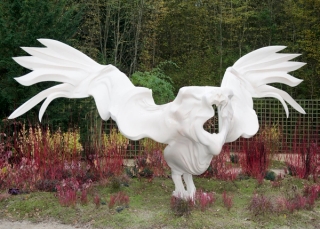
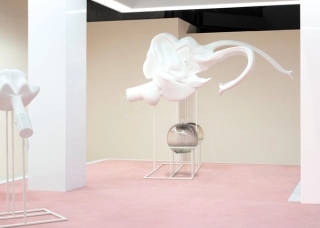
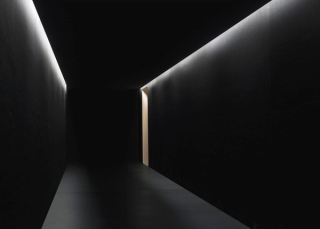
As early as in ‘FOXP2’ (2016), Humeau wondered how the world might have turned out if the first intelligent beings to emerge from the primordial soup had not been humans but socially savvy elephants.(5) The work’s title refers to the scientific speculation that, as a result of its mutating 100,000 years ago, the gene FOXP2 could be part of the reason that Homo sapiens followed a different evolutionary path to other great apes, such as the chimpanzee – all because an alteration in the structure of the vocal tract triggered the formulation of spoken language.(6) To access ‘FOXP2’, visitors first had to walk down a dark corridor where an audio installation simulated 108 billion Homo sapiens voices (2016). Using samples of a woman’s voice, the artist speculates about how the first humanoid ape came to speak, while simultaneously a choir of voices gradually builds, representing all of the people who have ever lived on Earth.(7) This corridor led to a showroom with rose-coloured walls containing ten white sculptures that appeared to be pursuing a mysterious life of their own, each showcased on a low, minimalist plinth placed on soft pink carpeting. Accompanied by a sophisticated light show, the space also featured an acoustic piece comprising hypothetical elephant language. Some of the sculptures were linked by rubber hosing to alchemical flasks filled with nutrient solutions. The fluid circulating in, for example, ENID, A female engineered to cry out of sadness (2016) contains a powder from a hormonal depressant and three teardrops from a Thai matriarch elephant collected by the artist in 2015. The slowing heartbeat of the matriarch elephant sets the pace for sounds issuing from the sculptures’ depth: just as it acquired life, something in this extremely emotional drama seemed to be perishing.
These biomorphic figments are based on 3D designs that drew, among other things, on the anatomy and foetuses of modern elephants, but also on fragments from mummified mammoths. There are resonances of natural history’s museology in these model bodies, carved from foamed thermoplastic polystyrene by computer-controlled robots, then finished with a perfect coating of matte-white acrylic. After all, public museums use sculptural processes based on fragmentary fossil finds, images and pure speculation to visualise extinct species such as dinosaurs.(8) But where the institutions of natural history wield their authority by presenting special effects as objective facts, Humeau proposes critical reflection. To this end, she had the pink carpeting in ‘FOXP2’ dyed with a potion consisting of the chemical components that make up the human body, as if to suggest that human beings are headed for liquidation.(9)
The wider installation also infers a cultic temple housing the peculiar ritual of an animal community – a place for deities and new mythical fantasies. Here we were able to drift into parallel reality, especially if we were to come too close to the flooring. The textile was also steeped in an extract of Datura stramonium or thorn apple, a poisonous flowering plant of the nightshade family that can induce hallucinations and is known for its use by witches in rituals. There is also speculation that devil’s trumpet (as this plant is also called) might be the forbidden fruit referred in the Book of Genesis, in which Eve grants humanity access to the Tree of Knowledge with the help of Satan disguised as a serpent.(10) The viewer in turn participates in the vision proposed by ‘FOXP2’: a ‘wake-opera’ where they bear witness to the death of the matriarch elephant. In the artist’s telling of it, this loss triggers the evolution of the grieving beasts around her, who are programmed to embody feelings such as sadness, melancholy and drunkenness, but also love, amazement and wonder. Contrary to the assumption that evolutionary change is driven by male-dominated biological ancestry,(11) this work adopts a matrilinear narrative characterised by elective affinities, alliances and, above all, emotions. The vibrant, resonating bodies, with their duplications and triple trunks, are at once ghostly and, to the artist, ‘beings that are alive’.
meys: Far beyond our senses
The complexity that we encounter in every work by Humeau generates so many questions and pathways that it risks becoming a dizzying affair, just as the taming of the chaos of evolution did for Charles Darwin, which he described in 1859 as a ‘web of complex relations’.(12)Those who experience Humeau’s work are likely, in any event, to experience ‘the incredible feeling of an unknown Nature’.(13) Such a feeling is carried through to the artist’s more recent installation ‘meys’, the title of which is derived from a proto-Indo-European root word that could have meant ‘change’, ‘ferment’, ‘foam’, ‘mix’ or ‘bring together’ (there is actually no record of this hypothetical language, which was first linguistically reconstructed in the 19th century). In this instance, Australian termites are the companion species, their symbiotic relationship with fungi raising profound questions about collectivity and cooperation. Civilisations of social insects appeared on the planet a hundred million years before humans and termites, and date back to the Jurassic period – a time in which the dinosaurs lived.(14) Social insects are feral beings that cannot be domesticated like cattle: they care nothing for human demarcations and are capable of reducing our homes to dust. But insects, omnipresent and species-rich, also keep complex ecosystems alive – they are central to the maintenance of ecological balance and biodiversity and encompass the majority of life forms on our planet.
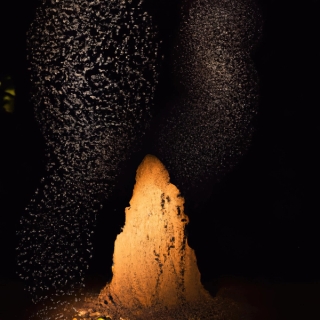
Visitors to the ‘meys’ exhibition at White Cube Bermondsey did not begin their journey with these creatures, but with a relief of fired and glazed clay entitled The History of Old Kent Road (Post-Kossowski) (2023). It was inspired by a figurative work made in 1965 by an artist with a biblical forename, Adam Kossowski, who emigrated from Poland with his Jewish wife Stefania Szurlej – and who died in 1986. Still visible on an outside wall of what used to be the North Peckham Civic Centre (a building just south of Bermondsey currently scheduled for demolition, although the tiles are listed and will be relocated), it takes as its theme the history of London, presented as a linear narrative. Humeau collaborated with Kossowski by asking him, during a séance assisted by the AI language model GPT-3, how he wished to see his work continued. If the primordial soup and matrix for the 21st century are the internet and code trained on the collective human consciousness, Humeau’s sequel to Kossowski’s work, though hand-produced with the help of a community ceramics workshop in East London’s Stoke Newington, features no people. Instead, under honey-like glaze, we see fragile, organic structures reminiscent of mushrooms and woodworm adorning a fragmented version of the mural that takes flight across the gallery walls. Broken down according to the Fibonacci sequence, the ceramic pieces wrap the space and then disperse, leading visitors to an adjoining corridor with a black-and-white film at its far end. This work, Collective Effervescence (2023), created by the software Dall·E and a human animator, features images that guide the audience into the heart of a termite mound, where the swarming creatures are performing a ritual dance around spiral-shaped fungi.(15)
Here, once again, reality and speculation merge: some termite species really do cultivate mushrooms inside their mounds. One might even argue that these multitudes made the leap from hunter-gatherers into farming long before the evolution of Homo sapiens.(16) As the writer and beekeeper Maurice Maeterlinck observed back in 1927, ‘indeed there can be no doubt that [...] the termite knows more than we do.’(17) Using the stars as their compass to return from foraging expeditions,(18) termites demonstrate behaviour that entomologists have compared with either the prevailing communication technology of the moment – from Morse code to the computer – or else with a force verging on the supernatural and ‘far beyond all our senses’, to quote the biologist and poet Eugène Marais.(19) As appraised by writers, from anarchist Pyotr Kropotkin to ecologist and anthropologist Kinji Imanishi, social insects have for eons been perfecting the art of mutual aid: self-management founded on cooperative communication, division of labour and the concerted action of the collective, which, in the battle for resources, has enabled them to outmanoeuvre solitary animals.(20) Social insects have inspired many different stories and Humeau, a poet and storyteller, has a tale of her own to tell. And so, as the sound of a composition by saxophonist Bendik Giske gathers and swells in a semi-darkened atrium, the viewer is lured away from the film work and into the principal exhibition space, and is confronted there by an ensemble of 17 separate sculptures. On this occasion, production began with process coding to simulate forms, with the still images translated (as they were in ‘FOXP2’) into foam moulds by robots. The implementation of the actual carving was performed manually by artisans expert in manipulating organic substances: here, wax tinted with earth pigments, 150-year-old walnut wood, ash, bronze, terracotta and glass. Some of these works are habitats for microsocieties, such as The Guardian of Ancient Yeast and The Guardian of New Yeast (both 2023), though their scale makes the termite mounds eerily human. The Guardian of Termitomyces (2023) alludes in its title to the termite mushroom, with which the insects form a symbiosis. There are allusions to other social insects, such as bees: The Honey Holder (2023) evokes waxen, aromatic honeycombs, which the mythical Greek inventor Daedalus is said to have borrowed from the wonders of the animal kingdom to construct his very own golden honeycomb for the Temple of Aphrodite on Mount Eryx,(21) and in The Forager for Honey (2023), leaves of wax are layered into a vaginal form. The arrangement of hexagonal structures in The Holder of Wasp Venom (2023) suggests the subterranean, terraced, downward-growing nests of harvester ants, but also the gills of mushrooms, discs of bracket fungi, slugs or tongues. The eponymous poison is displayed in round, honey-coloured jars, and as in other sculptures, these dewdrop-like glass vessels take inspiration from the microstructure of the substances they contain.
Known for their metamorphic skills, insects epitomise the capacity for and state of constant change. Humeau highlights this not only by reminding us that language is an unstable construct – ‘maze’, the homophone of ‘meys’, invokes an intricate if not confusing network of passages – but above all in her considered choice of materials. The team worked with natural beeswax, but also with a microcrystalline wax derived from distilled oil, a material technically composed from the liquefied bodies of primordial beings.(22) Even more to the point: wax, that ‘stuff of strangeness’ long used in magic rituals, begins as soon as it is slightly warmed to lose its shape and take on an ‘afterlife’,(23) as demonstrated by one of the four ‘Guardians of Termitomyces’. In its very polymorphism, wax embodies the instability, inconstancy and plasticity of normative models and indicates how, within experimental systems, the material objects of research must themselves each time be defined afresh, and have no fixed, inalterable form.(24) Wax, moreover, is an undead substance in between states, and the other materials in ‘meys’ are similarly ambivalent. The 4,500-year-old yeast that is preserved in some of the installation’s glass vessels might live forever, and the dead wood might once again become a habitat for mushrooms, worms or larvae. In the glass structure called The Brewer (2023), some materials are mixed into an elixir, so that the references themselves swirl and ferment. Yeasts have been used since the Stone Age to make staples in the human diet such as bread and beer. In fact, these microorganisms brought early human communities together – a reference to historic South London’s mills and breweries.
Ultimately, Humeau invites us to wonder what the human animal could learn from how social insects organise themselves. All these creatures form so-called insect states: well-functioning networks that consist of up to several million individuals. In debates about the human spatial, social and moral order, all kinds of ways of organising communities from monarchism to socialism have been compared with these animal societies. But the assumption of a purported organic unity has also been abused to justify totalitarian systems, for example when the Volkskörper (‘national body’) is conceptualised according to nationalistic and racist convictions. ‘meys’, however, suggests another route and we are ‘reminded again of the fairy godmother who waves her wand’.(25) Even the installation’s acoustics urge us to reject the lure of the lockstep in favour of ‘being singular plural’.(26) The musical composition may be sounded out by a single saxophone, but we hear what sounds like a diversity of voices, rather like an orchestra when the instruments are all tuning up together. The piece is designed as a continuous loop of individual parts, one able to sustain a perpetually changing pattern for the duration of the exhibition (and, in fact, for millions of years), never quite coalescing into harmony. ‘meys’ alerts us to secret, endlessly evolving networks that we cannot decipher, and to multiple, heterogeneous perspectives.
Orisons: Caring for dust
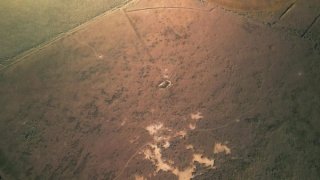
Eventually, Humeau left behind controlled laboratory conditions and well-equipped exhibition venues, with their electronic and architectural infrastructures. To create the earthwork ‘Orisons’, she struck out to a location that like all places on Earth dates back to the Eocene epoch (roughly 54 to 33 million years ago), where teeming abundance is not merely conceptual.(27) The title evokes a spiritual dimension; in Old English the word ‘orison’ means prayer, in French the word sounds like orée, which translates as cusp, edge, periphery. Humeau has previously worked with outdoor installations – a garden in Versailles, France, was the setting for Riddles (Sphinx Otto Protecting Earth from Humankind) in 2017. And while fauna had already held positions of agency in previous works – in ‘Surface Horizon’ (2021) putative weeds became lead protagonists – ‘Orisons’ takes these interests to very different level and scale. The earthwork is the result of a partnership with the non-profit Black Cube Nomadic Art Museum, which occupies a circular 160-acre site, 800 metres in diameter, at Hooper, in Colorado’s San Luis Valley, four hours from Denver. The Jones family, who own the site, have been running their organic farm here for four generations, formerly with the aid of centre-pivot irrigation, a system still used on arable farmland in the area. The equipment rotates around a central tower, with crops being watered by sprinklers. Whereas ‘meys’ drew our attention to microsocieties operating out of our sight or below the threshold of human perception, ‘Orisons’ addresses our being on this earth at a macro scale: here, the farmers, like termites, have developed in symbiosis with their local ecosystem. Seen via Google Earth, Humeau’s earthwork resembles an archery target, a radar screen, a clock, or a corn circle left behind by extraterrestrials. In land art of the 1960s and ’70s, such views from outer space were a familiar sight, and artists co-opted heavy industrial machinery to construct such large-scale creations. Humeau, however, builds upon ecofeminist discourse, which criticises the scarring and violation of the surface of Earth.(28)
At first sight, this region – over 2,000 metres up a gigantic alpine basin – looks barren. Under dramatic skies, to the West, the San Juan Mountains loom on the horizon; to the East, driven by an unrelenting wind, monumental sand dunes lie against the Southern Rocky Mountains and the Sangre de Cristo ridge. This entropic scenery, the result of a primordial volcanic explosion, was once a lake, then a swamp. Now it is a desert, hit by global warming, groundwater overdrafting (when more water is pumped out of the ground than can be replaced by natural sources) and, across the last two decades, megadrought. For the artist, this makes ‘Orisons’ a ‘post-climate world, a celebration of the lives, physical or mythological, that may go extinct’.(29) Therefore, Humeau is careful to keep her feet on the ground; her work in the field is not invasive. Instead, she responds to the history of the place, both in terms of the human interventions at surface level and geological deep time. In the San Luis Valley, Ancestral Puebloans, an ancient Native American culture, can be traced back to around 700 CE. Wanting to honour the weight of history, Humeau talked at length to the Ute Mountain Ute Tribe of Towaoc, the modern-day inhabitants of the area, and other indigenous communities, about the area’s sacred sites and mourning the land.
The map Humeau has created to help visitors navigate the site, and which resembles a starry sky, is not intended to chart the ecosystem under investigation. This land is constantly changing, and so both the ‘Orisons’ site and ‘Ghost map’ series (2022–ongoing) are open to diverse interpretations and, above all, to myth. These ‘Ghost map’ watercolours, which recall spirit photography of the 19th century, trace the movements of a wide range of the area’s protagonists, such as animals, plants and human-made infrastructure, but also the atmosphere, across space and time. Additionally, Humeau consulted a broad spectrum of local stakeholders (who have taken responsibility for stewarding the land and its flora and fauna) on the site’s people, mythology, archaeology and geohistory.(30) The entrance zone is defined by a disused cattle guard but, like the other vestiges of human use, it reflects neither a romantic delight in ruins nor picturesque disrepair. Visitors are otherwise left to explore for themselves. ‘Orisons’ proposes a dynamic of creation and ruin – as the philosopher and sociologist Georg Simmel once observed, these can be locations where nature and people collaborate.(31) They do not inevitably give cause for melancholy and grief but can also offer agency. This function is supported in ‘Orisons’ by a phial that was handed out at the earthwork’s opening event by Humeau, which contained a blue elixir made from local plants, grain alcohol and spirit essences, such as the dust of sand dunes.(32)
Elixir notwithstanding, visitors to ‘Orisons’ can choose very different pathways by suggestion of the map. We can be guided by our feelings: good, sweet, mixed, pain, despair. We might meet creatures such as kangaroo mice, prairie dogs, a horned toad or red ants, contemplate plants such as tumble pigweed, Japanese brome or spike bentgrass, all of which have adapted to the harsh conditions – some of the local flora is nomadic and never puts down lasting roots. ‘Orisons’ is not least an archive for past emotions and memories. The artist, by way of the map she has created, points us towards the grave she made for a dead bird or to the skeleton of a cow (A Solitude That Is Inhabited, 2023). Three clairvoyants, or geomancers, independently sensed the presence of A 150-Year-Old Sadness (2023) in a spot marked by a jumbled wire fence. Here, as the artist reports based on the clairvoyants’ respective findings, the spirit of a woman is trapped; her family tried to settle on this land in 1850, but she passed away, probably due to the harsh climate.
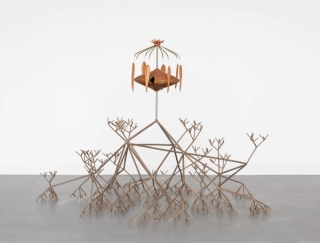
Throughout the site there are simple benches made by architect Ronald Rael from sun-dried adobe bricks (the region’s traditional indigenous building material) that are reminiscent of the termite architecture that features in ‘meys’. Earth is a modest substance and so ubiquitous that we hardly notice it,(33) but like wax, it is versatile and malleable. There are many creation myths where bodies emerge from mud; in the end, insects and the elements break our corpses down into dust and humus, a composite from which new life can spring.(34) As science historian and philosopher Donna Haraway put it: ‘human beings are not in a separate compost pile. We are humus, not Homo, not anthropos; we are compost, not posthuman.’(35) The soft interventions Humeau has introduced to the landscape encompassing the ‘Orisons’ circle are inconspicuous, and they act as portals onto other worlds. The artist has placed small metal objects that might suddenly glint in the sun. Currents of air erase human traces over time, but these 84 sculptures made of recycled steel and wood respond to the flow, testifying to the artist’s collaboration with the atmosphere: ‘some of them […] spin in the wind, some of them at high wind, some of them in a storm’.(36) In size, design and titles, these pieces reflect the micro- and macrostructures of the weeds all around: Spurge Dances, Horseweed Pendulum, Russian Thistle Spins (all 2023) – plants often categorised as invasive species and that, as the artist points out, have become extinct in our mental landscapes. At the same time, these objects resemble tools of divination, and are placed in locations where the geomancers had identified traumata in the land.
The voices of the plants and earth are literally amplified, vis-à-vis the sculpture-instruments performing an ever-changing opera. These sounds – spooky echoes bouncing across the site – are uniquely percussive and bring to bear the different rhythms of the land. When the separate beats coincide by chance, they invoke a rainstorm. One inspiration for this sound was a YouTube recording of a human choir whose members use their bodies to produce the notes required in order to perform the natural phenomenon. Similarly to the music in ‘meys’, this work asks how singular entities can interact with each other to create an order of a different kind. Additionally, taking its cue from Ute Mountain Ute Tribe of Towaoc members Regina Lopez Whiteskunk and her father – who blessed the land when the project began(37) – ‘Orisons’ enacts a ritual for inducing precipitation. Humeau’s sculptures play, accordingly, not only with the shapes of raindrops and ripples on water, but also produce corresponding sounds and rhythms.
The principal companion species referenced in ‘Orisons’ is the native grey sandhill crane with its red crest, to whom Humeau has dedicated seven large sculptures. They are coloured in sunset shades of blue, pink and orange, and are set with horsehair and blue onyx and sodalite stones. Sandhill cranes are one of the oldest living avian species in the world; there is what is thought to be a 3,000-year-old petroglyph of one on the wall of a rock shelter at nearby Dog Mountain. These birds migrate across the land in spring, and in Native American mythology represent the rebirth of nature and the approach of rain. Visitors can – similar to the way one can on the wooden ‘Fallen Leaf I–V’ (2023) seesaws in ‘meys’ – lie on the wing-shaped hammocks to rest and look at the sky, while the nearby flute sculptures recreate whistled notes from the crane’s song.
The artist does not use her works to generate conventional knowledge, but rather for its inverse: ‘non-knowledge, or to be more precise, the very fragility of the seemingly so safe epistemic foundations of a modern, scientifically organised way of life’, to quote art historian Herbert Molderings.(38) There is a German verb that beautifully captures the emotion released here: schwärmen. Apart from sounding out the swarming of insects, the word further suggests enthusiasm and a lost sense of reality. Schwärmer are ecstatic daydreamers – as the artist says of ‘Orisons’: ‘It is about letting this ghost invade you and surrendering to it to better mourn it.’(39) The phial of blue elixir, in homage to the tinctures and ointments of witches that have been designed to help people fly, may support the process; it is surely no accident that UFOs have been sighted over ‘Orisons’. Investigating this aspect further in ‘Dust’, her 2024 exhibition at White Cube in Seoul, Humeau created a series of intricate sculptures that visualise the activation points of the site as spacetime portals (in the manner of a physicist modelling elemental forces), with reference to the protagonists of ‘Orisons’.(40)
All in all, with their pathways to deep time, Humeau’s experimental systems allow us to meditate upon what our own future might look like, and what will be out there once those who confront the climate emergency are turned again to dust. Jones Organic Farming and the indigenous communities in Colorado’s San Luis Valley have certainly come up with a way in the Here and Now to emulate the termites, by regenerating the soil and enhancing biodiversity.(41) The question that now preoccupies Humeau is no longer just how to imagine alternative worlds, but how to survive the present.
- Grateful thanks to Marguerite Humeau for providing a wealth of information about her works, and to Elaine Tam for her generous assistance with the research for this piece.
- See Hans-Jörg Rheinberger, Toward a History of Epistemic Things: Synthesizing Proteins in the Test Tube (Redwood City, California: Stanford University Press, 1997)
- Gilles Deleuze and Félix Guattari, A Thousand Plateaus: Capitalism and Schizophrenia, 1980 (London, New York: Continuum, 2009), p.286
- Humeau as quoted in ‘Interview with Armelle Leturcq’, CRASH Magazine (2019), pp.101–07; and John McPhee, Annals of the Former World (New York: Farrar, Straus and Giroux, 1998)
- For funeral rites of elephants, see Martin Meredith, Elephant Destiny: Biography of an Endangered Species in Africa (New York: Public Affairs, 2003), pp.184–86
- Jared Diamond, The Third Chimpanzee: The Evolution and Future of the Human Animal (New York: Harper Perennial, 1993)
- For all the sound components in ‘FOXP2’, the artist collaborated with Pierre Lanchantin, Laboratory of Voice Synthesis, University of Cambridge.
- See Petra Lange-Berndt, Animal Art: Präparierte Tiere in der Kunst 1850–2000 (Munich: Verlag Silke Schreiber, 2009) p.161
- See in general Dietmar Rübel, Plastizität: Eine Kunstgeschichte des Veränderlichen (Munich: Verlag Silke Schreiber, 2012)
- See Per Faxneld, Satanic Feminism: Lucifer as the Liberator of Woman in Nineteenth-Century Culture (Oxford University Press, 2017)
- See Bram Dijkstra, Idols of Perversity: Fantasies of Feminine Evil in Fin-de-Siècle Culture (Oxford University Press, 1986), p.210
- Charles Darwin, The Origin of Species by Means of Natural Selection: Or the Preservation of Favoured Races in the Struggle for Life, 1859 (London: Penguin, 1985), p.125
- Deleuze and Guattari, p.265
- See in general Bert Hölldobler and Edward O Wilson, The Superorganism: The Beauty, Elegance, and Strangeness of Insect Societies (New York and London: WW Norton & Company, 2009)
- Collective Effervescence, the title of Humeau’s film, refers to Émile Durkheim, The Elementary Forms of the Religious Life, 1912, trans. Joseph Ward Swain (London: George Allen & Unwin, 1964)
- Hölldobler and Wilson, p.408
- Maurice Maeterlinck, The Life of the White Ant, 1927 (London: George Allen & Unwin, 1944), p.77
- Hölldobler and Wilson, p.118
- On analogies with mass communication technologies, see Eugène Marais, The Soul of the White Ant, 1925 (London: Jonathan Cape, 1970), p.27; see also Hölldobler and Wilson (2009); for the quote, see Marais, p.30. The artist herself has referred to the writings of Marais.
- Pyotr Kropotkin, Mutual Aid: A Factor of Evolution, 1902 (London: Freedom Press, 1987), pp.27–33, 235; Hugh Raffles, Insectopedia (New York: Random House, 2010), p.66
- Claire Preston, Bee (London: Reaktion Books, 2006), p.100
- Honey and wax were sourced from hives on the roof of White Cube, Bermondsey, London.
- Georges Didi-Huberman, ‘Die Ordnung des Materials. Plastizität, Unbehagen, Nachleben’,Vorträge aus dem Warburg-Haus 3 (1999), pp.3–29; for a partial translation, see Petra Lange-Berndt, Materiality: Documents of Contemporary Art (Cambridge, Massachusetts: MIT Press, 2015), pp.42–53
- Rheinberger, p.28
- Marais, p.110
- See Jean-Luc Nancy, BeingSingular Plural, 1996 (Redwood City, California: Stanford University Press, 2000)
- See project website orisons.art (Accessed 10 March 2024); Jared Maxwell Beeton, The Geology, Ecology, and Human History of the San Luis Valley (Denver: University Press of Colorado, 2020)
- See, for instance, Ends of the Earth: Land Art to 1974, published on the occasion of the eponymous exhibition at The Geffen Contemporary, MOCA, Los Angeles, 2012.
- Humeau, as quoted in Rebecca Lamarche-Vadel and Cortney Lane Stell, ‘Inside the Cover’, Cura 39 (2022), pp.89–133
- See orisons.art/about (Accessed 11 March 2024)
- Georg Simmel, ‘The Ruin’, 1907, The Hudson Review 11, 3 (1958), pp.379–85
- The elixir was made by DRAM, see https://www.dramapothecary.com/?v=7516fd43adaa (Accessed 11 March 2024)
- Monika Wagner, Das Material der Kunst. Eine andere Geschichte der Moderne (Munich: CH Beck, 2002), p.110
- See Petra Lange-Berndt, ‘Ecosexuality – On the Many Genders of the Material Earth’, Further Thoughts on Earthy Materials, exh. cat. (Gesellschaft für Aktuelle Kunst Bremen, Kunsthaus Hamburg, 2020), pp.114–36
- Donna Haraway, ‘Tentacular Thinking: Anthropocene, Capitalocene, Chthulucene’, e-flux journal 75 (2016), pp.1–17
- Humeau, as quoted in the visitor site map produced for ‘Orisons’.
- Emily Watlington, ‘Marguerite Humeau’s 160-Acre Earthwork in Colorado Honors a Planet in Incurable Pain’, Art News (10 August 2023), artnews.com/ art-in-america/features/margue- rite-humeau-orisons-earthwork- colorado-1234676767/ (Accessed 11 March 2024)
- See Herbert Molderings, ‘It Is Not the Objects That Count, but the Experiments. Marcel Duchamp’s New York Studio as a Laboratory of Perception’, Re-Object, exh. cat. (Kunsthaus Bregenz, 2007), pp.146–54
- Humeau, as quoted in Lamarche-Vadel and Stell, 2022, p.123
- See ‘Marguerite Humeau: Dust’, White Cube, whitecube.com/gallery-exhibitions/marguerite-humeau-seoul-2024 (Accessed 31 July 2024).
- See in general Anna Lowenhaupt Tsing, The Mushroom at the End of the World: On the Possibility of Life in Capitalist Ruins (New Jersey: Princeton University Press, 2015)
.jpg?w=320&q=100&auto=format)
.jpg?w=320&q=100&auto=format)
.jpg?w=320&q=100&auto=format)
.jpg?w=320&q=100&auto=format)
.jpg?w=320&q=100&auto=format)
.jpg?w=320&q=100&auto=format)
_2023_Image_credit_©_White_Cube_(David_Westwood).jpg?w=320&q=100&auto=format)
.jpg?w=320&q=100&auto=format)
_2023_Image_credit_©_White_Cube_(David_Westwood).jpg?w=320&q=100&auto=format)
_2023_Image_credit_©_White_Cube_(David_Westwood).jpg?w=320&q=100&auto=format)
_2023_Image_credit_©_White_Cube_(David_Westwood).jpg?w=320&q=100&auto=format)
.jpg?w=320&q=100&auto=format)
.jpg?w=320&q=100&auto=format)
.jpg?w=320&q=100&auto=format)
.jpg?w=320&q=100&auto=format)
_Traces_of_machinery_observed_from_satellites_Other_traces_of_unidentified_presences_2022_Image_credit_©_White_Cube_(Theo_Christelis).jpg?w=320&q=100&auto=format)
.jpg?w=320&q=100&auto=format)
.jpg?w=320&q=100&auto=format)
.jpg?w=320&q=100&auto=format)
.jpg?w=320&q=100&auto=format)