Marguerite Humeau: Art, Science, and Speculative Fiction
Belén Vera
From Neo2, Issue 154, Madrid, ES, 2025
Belén Vera: Tell us about your beginnings. Do you remember what sparked your interest in exploring speculative worlds and almost mythological narratives?
Marguerite Humeau: Back in 2009–201, while studying at the Royal College of Art in Design Interactions, I became fascinated by replicating voices. After a workshop on biotech, I wondered: what if we could recreate the voice boxes of famous singers so that, even after death, we could hear them perform new songs in an analog way? From there, I imagined an opera of the dead, and eventually the voices of extinct creatures.
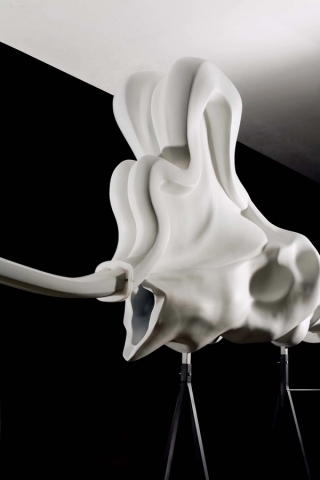
This became my graduation project: an opera of prehistoric animals, where I tried to resuscitate the voice of a mammoth and others. Since vocal cords don’t fossilise, I spoke with paleontologists and biologists, but realised that speculation was where my role as an artist began. Where science ended, imagination stepped in.
Since then, I’ve expanded this research, treating each project as a point on a space-time diagram connecting us to distant places and moments. I still collaborate with experts, not only scientists but also foragers, clairvoyants, geomancers amongst others. Each offering specific, situated knowledge in their own way. My role is to weave these forms of knowledge together with imagination and research, creating works that exist in the interstices between oral knowledge, scientific knowledge and speculative fiction, exploring how things might have been and how they might still evolve.
BV: Your creatures often seem to exist in a liminal state between machine, animal, and mythological being. What do you hope we experience when we encounter them?
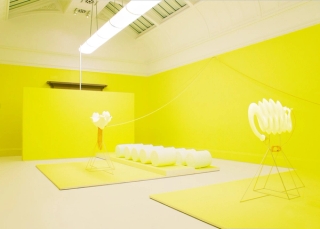
MH: In my earlier works, I was very interested in the idea of luminous horror, a kind of horror that is bright and seductive, yet at the same time terrifying. Close to the concept of the sublime, it is about being in awe while simultaneously feeling dread. I wanted to create environments that looked attractive and full of light but always carried an element of danger.
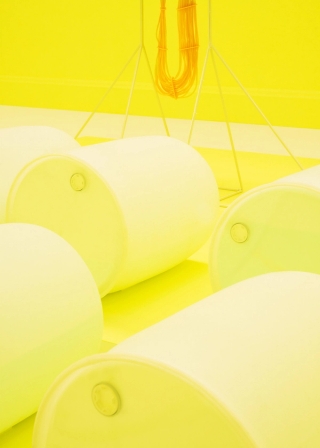
In Echoes (2015), for example, the entire room was covered with black mamba venom, one of the deadliest in the world. Its fluorescent yellow made the space feel radiant and inviting, but once you realised its toxicity, beauty turned into threat. That tension between allure and danger occupied me for several years.
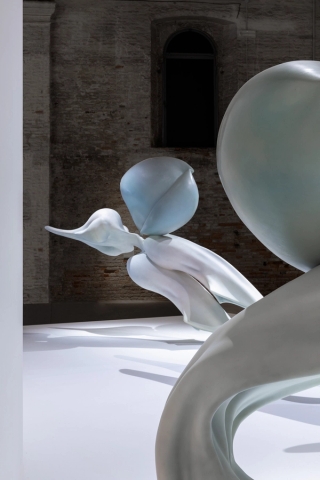
Now my focus has shifted, though wonder remains central. I’m interested in how humans experience and become involved in the worlds I create, especially through scale. In meys at White Cube, fungal and honeycomb-like structures played with proportions: some almost human-sized, others towering at two meters or more, taking on the presence of semi-gods or landscapes.
I also make very small pieces that require care and attention. Viewers might need to crouch or bow down, creating a more intimate encounter. Depending on the project, I want people to feel wonder, curiosity, discomfort, or terror. It all depends on the world each piece opens.
BV: How important are drawing and sketching in your process before turning ideas into sculptures? Can you walk us through your creative process?
MH: I spend a lot of time sketching, and usually my process begins with an idea—often a question about where we are heading, what kind of speculation I want to explore, and what it reveals about our world today. Once I settle on a direction, I gather images, many from the natural world during walks or hikes, others from various sources.
For example, in meys at White Cube in London, I wanted to create an environment where visitors encountered beings evolved into collective organisms. Traveling in Australia, I researched termite mounds, and this research became the foundation of the project. From there, I imagined “characters”, guardians of yeast, of a fungus garden, a honey forager, and sketched them by hand to build a narrative.
I work really closely with 3D designers. Using my archive of reference images, microscopic fungi, beehives, natural structures, I ask them to replicate or reinterpret forms digitally. This becomes a toolbox to sketch in 3D. More and more we code growth systems into the software so structures evolve organically, like honeycombs or fungal colonies.
The process is long and full of back-and-forth, but deeply generative. My hand sketches and 3D models develop side by side until reaching a point where the ideas can take physical form.
BV: Many of your works are made with materials like wax, wood marked by fungi, glass, honey, wasp venom or yeasts. At what stage do you decide on the materials for a work? How important is the material itself in shaping your projects?
MH: I think it really depends. With meys, for example, I knew from the beginning I wanted to create living forms made of wax. My intuition was that if I was creating a work about collectivity, I should use materials born of collective activity, like wax, but also wood eaten by termites. Various human communities were also involved in some of the processes, such as the ceramic mural in the show.
Other times the material comes later. For my Miami show, I imagined a world where terrestrial beings have to become creatures of the air. Studying birds and nests, I realised textiles made sense—light, flexible materials that could exist in the air. We worked with fashion designers, experimenting with silk, felt, embroidery, and developed the work step by step.
For my upcoming New York show in a cave, I drew on a process from Miami. We had waxed felt, and in places it resembled rock. That gave me the idea: instead of using literal stone, why not create our own? By treating and dyeing the felt, we can make it look and feel like rock, yet still control its color, texture, and solidity.
So the choice of material is a mix of intuition and discovery. Some emerge early, others reveal themselves as the project develops. Since each project is about creating an ecosystem, the materials must make sense within that universe.
BV: In meys, you worked with AI and specialised artisans. How did you combine digital tools and traditional techniques in your creative process?
MH: We always start with programming and 3D modelling. I’m very interested in how we reintegrate ourselves into ecosystems, since as humans we’ve created ways of living that are disconnected. In the past five years, I’ve been trying to place humans back inside these ecosystems, not at the center, but embedded more horizontally, with no hierarchy between forms of life.
More and more I am interested in creating works that are active agents within human communities. The works become protocols, rituals to come together. Chance and unpredictability are part of the works, and the stories I am generating become myths to be lived, embodied. They are more vulnerable.
I also work with humans who have special crafts to interpret forms designed by AI or other software. I look for artisans with highly specific knowledge, sometimes niche, even close to disappearing. Recently we collaborated with an onyx carver who works in extremely fine detail, and with glassblowers, which I love because what they blow is filled with their own air, their breath.
I usually share drawings with them and we work together on how the forms can be interpreted. When someone uses their hands or breath, adaptation is always needed, and I like that. What interests me is when artisans push beyond their own boundaries, creating something at the very limit of their knowledge or capacity. The result looks very human, but also slightly strange for humans to have made.
BV: As you mentioned, you’ve worked with archaeologists, paleontologists, neurobiologists, even clairvoyants. How does this fusion of science, technology, and mysticism come together in your studio?
MH: The discussions I have are very free. When I start a project, I’m genuinely interested in what people know or have to say. Things usually come together intuitively, and much of the knowledge overlaps. It’s rare that perspectives truly oppose each other; they just offer different views on the same situation.
For example, two years ago I worked on a large land art project in Colorado called Orisons. I spent two years researching the land with the idea of transforming it into an artwork that could connect its past, present, and future, along with all the beings passing through it. I spoke with soil scientists, did site visits with plant specialists, resource conservationists, historians, wildlife refuges, ornithologists, engaged with Indigenous communities, collaborated with local organic farmers, and also spoke with geomancers—people who can “read” landscapes almost like mediums. They gave me insights into the land’s history, its possible futures, and even presences they felt still lingered there.
Strangely, all this knowledge came together. Take the sandstorms, for instance: the local residents call them dust devils, they look like spirits traveling the land, while scientists explained their physical formation. To me, there’s no higher or lower point of view, it all connects to create stories. I usually gather all this knowledge, then spend time writing it down and linking ideas, which become the starting points for my artworks.
BV: Your pieces question anthropocentrism and imagine futures where humanity is no longer at the center. How does that relate to your own way of being in the world?
MH: During the pandemic, I asked a forager to teach me how to feed myself from what we usually call weeds, the plants growing in the city. I discovered that many, like dandelions in my courtyard, are edible. For a couple of weeks I worked with the forager, Lucia Stuart, who had me pick what looked good, then guided me on what it was, how to use it, and whether it was safe.
That experience shifted my perspective. These plants we often dismiss have incredible properties. Instead of weeds, we could see them as companions or guides: resilient beings that survive in harsh environments and even reveal ecological changes, like oracles pointing to futures we don’t yet know. Seeing them this way changes how you live, how you connect, and how you understand your place in the greater web of life. Some extinctions exist in our mental landscapes, not only physical landscapes.
BV: Voice, music, and ritual are essential in your practice. What do sound or performance express that sculpture alone cannot?
MH: Because I’m interested in presence. The worlds I create don’t exist, they have ceased to exist, they don’t exist yet, or they exist in parallel presents. In a way, they are like ghosts, and my work is about bringing them to life or giving us humans a sense of their presence.
A sculpture gives a physical embodiment, but there are other ways to suggest presence beyond the physical. Voice has been central to my work from the very beginning. My first sculptures were voice boxes of extinct creatures, and I wasn’t interested in them as objects, I wanted to create sound. The sculpture was only there to generate the voice. They were speaking together, listening to each other, and their language was evolving as a result.
That showed me how powerful sound can be in creating presence. When you hear a voice, you can almost enter into dialogue with these entities. Later I recreated the voice of Cleopatra, asking her to sing a love song in extinct languages. That piece had no physical form, only sound, yet it was powerful because with just a voice you can imagine everything else. She becomes timeless, traveling through space and resonating across history.
Since then, most of my projects have had voices, breathing, or rhythms emanating from the sculptures. In meys, I wanted the sculptures to have a pulse. I asked saxophonist Bendik Giske to create rhythms and swarms of sound , never looping, always shifting, like an orchestra searching for harmony. This piece was driven by chance.
More recently, I worked with scores. For a film in the Colorado desert, I collaborated with musicians to compose an actual musical score, the first time I moved beyond voices and rhythms into something more narrative.
In Torches, I explored the origin of life. My hypothesis was that we were born not from matter, but from rhythms. The piece begins with quiet bubbles of sound that gradually synchronise into drumming, filling in an moving through a 150-meter gallery so visitors feel themselves like cells in an organism, synchronising together.
Sound allows me to move beyond form. It creates presence, resonance, and a shared rhythm that sculpture alone cannot.
BV: Lately your work seems increasingly tied to the climate crisis and ecosystems under stress, as in meys or Migrations. Do you feel a personal urgency about these issues?
MH: Yes, I do feel a personal urgency, like all of us. But my work is not political, nor about offering solutions. It’s about creating spaces of contemplation. In the past, people went to temples, churches, or gardens to look at the world differently; I’m interested in what new sacred spaces might look like today.
The climate crisis has been a starting point for a few projects, because it is a transitional time. Often my works begin with another “what if.” In FOXP2, I imagined language mutating in elephants, making them the dominant species. Each project begins with a shift, and from there, new worlds emerge.
The crisis itself is such a shift, a tilting point. While we live in a present emergency, I also want to think in longer timescales. In meys, for instance, I turned to termites, creatures that have survived millions of years of climate changes. They, like weeds, can be our guides. In the vast history of life, humans are just a flash.
My projects offer a sacred, spiritual, and contemplative space; a place to step back, imagine, and reflect.
BV: Your exhibition Torches is currently on view at Arken Museum and will soon travel to HAM Helsinki. Could you tell us about other upcoming projects and exhibitions you’re preparing?
MH: Helsinki is such a different space, so I’m curious to see how Torches translates there. At the same time, I’m preparing my new show at White Cube in New York, opening in January. For that, I’m focusing on a cave and thinking about how we live in dark times, or perhaps in darkness. I was wondering: who lives in darkness, and what can they teach us? Maybe there are new emotions that arise from living in darkness, emotions we don’t even have names for yet. I was inspired by a book by John Koenig called The Dictionary of Obscure Sorrows, where he invents words for emotions that haven’t been named.
So I’m using a similar principle, imagining emotions that emerge in darkness and associating them with cave-dwelling entities, asking what lessons they might offer. For example, when you look at a stalagmite, it seems monumental, but it’s been formed by thousands upon thousands of drops of water over millions of years. Maybe that’s a metaphor, that real change doesn’t come from grand gestures but from small, patient acts of care. So each entity in this cave world will carry its own emotion.
.jpg?w=320&q=100&auto=format)
.jpg?w=320&q=100&auto=format)
.jpg?w=320&q=100&auto=format)
.jpg?w=320&q=100&auto=format)