Between Science and Séance, Marguerite Humeau and Susanna Greeves in conversation
Susanna Greeves
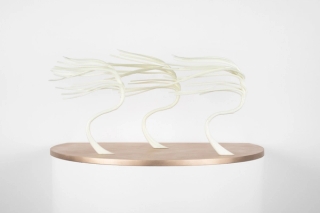
From Auguries, White Cube, London, UK, 2025
Susanna Greeves: There are some consistent endeavours recognisable within your practice, such as the reanimation of dead, lost or forgotten forms of life, as well as an interest in identifying moments of beginning: the birth of consciousness or of spirituality or of community. But within the context of that singular purpose, I feel that these projects, ‘meys’, ‘Orisons’ and ‘Dust’, seem to represent a new chapter. Maybe we can talk about the special characteristics that they share. But first, I wanted to ask if you are aware of a turning point or a moment of conception for this shift?
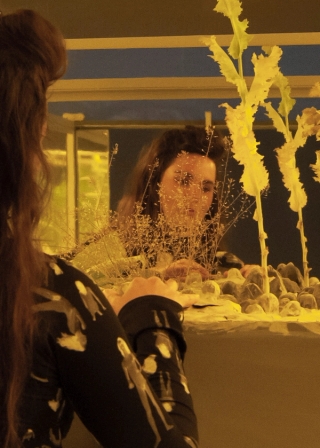
Marguerite Humeau: I think it came quite naturally. During the pandemic, I started foraging for food. I got in touch with Lucia Stuart, who is a forager and chef and eventually became a close collaborator, and I asked her to teach me to feed myself with the plants of London. It was quite a simple endeavour. She said, ‘I’m not going to tell you what you should pick, you should just go out there and pick whatever you want to eat and bring it back and show it to me, and I’ll teach you what you can and cannot ingest’. So we had that period together, and it was amazing because she’s also a highly spiritual person. She knows a lot of the mythology around plants, their significance and how they’ve been used in the past, not just for food, but also, for example, for dyes or different crafts or medicines.
I think that was a shift; I would say a conceptual shift and a personal shift, I guess. For many years I was preoccupied with understanding what is life and what is death, and what are the states in between. What happens when life is accelerated to a point where death does not exist anymore? Many of my projects were about exploring this concept and the horror that might result from annihilating death.
During the pandemic, I remember a questionnaire that had been released by [Bruno] Latour, the French philosopher, asking us to reflect on where we were at with the climate crisis, where do we stand? What should we do? How can we change our lifestyles and so on. It was quite overwhelming, and I started to really feel trapped. We were all trapped, obviously, physically, but also trapped on Earth somehow, like feeling there is nowhere to go. If you consider the theories that life originally came from outer space, then the universe is one whole thing, and even in the universe, we are trapped. It was a kind of existential realisation, and because I was foraging at the same time, I connected it with thinking about other worlds that had existed in other times, in prehistoric times or speculative futures. And I started to think of worlds that are here, right beneath our feet. Thinking of where we can find otherness, in the very soil where we walk. That was the shift.
It also got me thinking about extinction in a broader sense. I had been preoccupied by the extinction of actual physical beings or languages, but then I started to think that if something doesn’t exist in your imagination anymore, in a way it’s extinct. So it’s also to do with the extinction of imaginary beings or mental landscapes or what we don’t see or don’t pay attention to. Everything else kind of came from that.
SG: Would it be right to say that the first expression of that shift was in the exhibition that you had at Lafayette Anticipations? Could you say a bit about that show, ‘Surface Horizon’ (2021), and the form that it took?
MH: It was an open invitation from the curator Rebecca Lamarche-Vadel, who asked me and the artist Jean-Marie Appriou if we would transform the museum into a garden where we could bring to life this shift I have described, which I think many people had been feeling. It was an invitation to reinvent ourselves and to produce a show completely outside of our comfort zone. Obviously, I was really excited by it.
While I had been foraging in London, I had been realising that lots of plants we consider weeds are actually edible and they have lots of benefits, so that’s where I began my research. I developed the story of the show like an epic, traversing different strata of the soil, which are called ‘horizons’. I discovered the term ‘surface horizon’, for the layer that is not visible, but is right beneath the topsoil and is where all the greatest transformations happen on Earth. That’s where there is most life, and that’s where there are most metamorphoses. It’s where all the dead matter rests and may come back to life, and where all the dormant seeds lie. It was a little bit like finding a mythological place where we could conceptualise all the transformations that we humans were going through, and maybe we could find answers to some of the new ways of existing in the world.
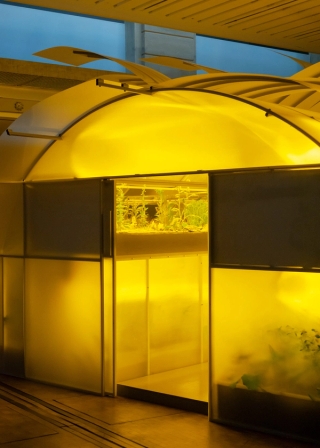
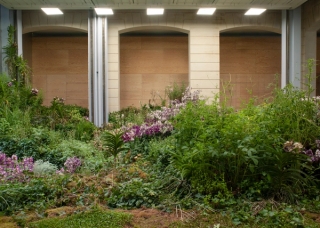
The Lafayette building has many horizontal levels, allowing us to imagine the building as a soil extrusion and each floor as a layer of the soil. One lush, lavish garden called ‘levitation’ was about plants used as decoration, bodies that are denied agency. On another level, a greenhouse-like pavilion, The Oracles of the Desert [2021], contained plants that are bioindicators, which I thought of as oracles, because they are plants that can indicate the health of the soil – for example, certain plants express that there is too much salt in the soil, like a premonition of the earth becoming desert. I also invited a medium to participate, engaging with visitors and asking people to describe what was dormant in them, thinking that, like the plants, she is also an oracle. On the second floor was a series of small wax sculptures I considered elixirs, that were attempting to describe emotions that we don’t yet have names for. And then on yet another level, there was a pavilion housing an insect called a periodical cicada or magicicada, which comes out every 17 years. We have quartz clocks, but maybe we could choose any presence or being that has a specific rhythm on Earth, to synchronise with the magicicada as our new clock. And then finally on the last floor I showed the first pastel drawings I ever made. I wanted to draw all the gardens I hadn’t yet made, like seeds that are still dormant and that might one day be brought to life.
SG: I can see from that description how many of the seeds from ‘Surface Horizon’ you can see flourishing in the other landscapes that you made. If ‘Surface Horizon’ was an artificial garden, then ‘meys’ was a kind of landscape, or woodland clearing in the gallery. You took forward the idea of the elixir in the narrative of the ‘meys’ sculptures coming together, bearing different ingredients for the making of an elixir. This was something that then appeared in ‘Orisons’ as well. Similarly, the attention that you gave to the ‘weeds’ I can see reflected in ‘Orisons’ in your respect for the heroism of those tough plants that hang on in the most arduous conditions.
MH: Yes, and in the termites of ‘meys’ that have that quality of thriving where other forms of life can’t survive. Because, you know, in the end it’s about looking at all these beings that we’ve totally disregarded, but that may hold some answers around how we can survive in specific climates, under specific conditions. So to me, the way we look at weeds, or we look at termites, or the way we look at pigeons in cities, it’s pretty similar. There might be other ways to encounter these beings and treat them more like companions or guides as opposed to pests, and the same applies to ways of thinking that we have discounted and overlooked.
SG: ‘Surface Horizon’ seems to mark a shift from your earlier research which sought information from authoritative voices, scientists and experts in their field. Would you say that that was the first time you started to cast the net more widely to less conventional sources of information and knowledge?
MH: Yes, for sure. For example, the practice of foraging is becoming more accepted and quite mainstream, but even ten years ago that wasn’t the case. I thought that if my own landscapes are getting bigger then this needs to be reflected in the way I research my work as well. But even before, when I was interviewing scientists, I was also always pushing them to jump into the unknown and speculate with me on worlds that don’t exist anymore or have not come into being yet...
SG: To the boundaries of knowledge.
MH: Yes, exactly. And to zones that were maybe not that comfortable for them, that they found amusing or slightly eccentric. In academia and the scientific field, there is a form of authority that you need to preserve and protect and there is less space for speculation with people who have accepted that, for example, intuition can be part of research, that even poetry is acceptable.
SG: And oral histories that are passed from individual to individual and may be held in the more marginalised portions of society.
MH: Yes. And when you learn from a person it’s very different from learning from a book where it’s exact science. You understand that what they know is based on words that maybe have been transformed over time or adapted, and that probably personal stories have also been included in the mix.
SG: So when you came to the ‘Orisons’ project, you sought all kinds of sources of knowledge and information about the land – both scientific understanding and oral histories, local histories. And even a kind of supernatural reading, which, again, we might trace back to the medium in ‘Surface Horizon’.
MH: Humans are at a dead end if we keep living this way, so we have to find creative ways to exist. We need to reinvent ourselves, and who are the humans who can help us? People with special talents or special ways of looking at the world that, again, have been dismissed, maybe it’s they who will be able to help us to see things we cannot see. So quite quickly I thought of clairvoyance or clairsentience or humans that can see dimensions that most humans may not be able to perceive. And I also thought that those people are like portals to other worlds. In some sense, I saw the sculptures I had been producing as portals to these other worlds. So I thought, actually, maybe there is not so much difference between being able to hear mammoths chanting and being able to converse with a clairvoyant human.
SG: It seems that you don’t create any sort of hierarchies between those different sources of knowledge and information that you seek out. They’re all equally valid resources for you.
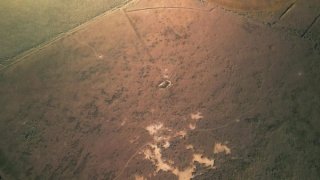
MH: Exactly. With ‘Orisons’, that became even more obvious and almost overwhelming because it’s such a vast land, and most importantly, the history of the area is so rich and goes back deep in time, and there have been so many histories and mythologies, and so many different human communities traversing or living on the land. There is so much to understand or to look at that it becomes a nearly impossible task. We met so many different people – from soil scientists to plant specialists to birdwatchers to farmers to UFO watchers. And every time we started a conversation, I felt we were opening up a thousand new discussions. I think, at the end, ‘Orisons’ is very much about that. There is a map that welcomes you when you arrive on the land. And the map is not really a map because it’s impossible to create a map, so it’s like a map trying to say everything and everything else. I think you can tell that it’s a map that’s constantly in progress, only one glimpse of the thousands of possibilities of how you could have even tried to start to sketch a map, for the purpose of the artwork.
SG: You began by talking about the pandemic as well as the climate crisis. I think it’s fair to say that behind all of your speculative world-building, as well as in the way that you talk about your work, there is the premise that the extinction of humans as a species is likely, if not inevitable, and probably not very remote either. The specific proximity of a manmade climate crisis is particularly explicit in these recent bodies of work, more than ever before in your practice. And yet, I find the mood of your work is hopeful and imaginative and inquisitive – not fearful. Partly, perhaps, because your perspective is not human-centric, and partly because of the great spans of time that you encompass. But I did want to ask where you sit on this spectrum of fear and hope, especially when you talk about making practical preparations for having to feed yourself from the land. How do you confront this possibility, or reality, of human extinction?
MH: I think at times I’ve been very existentially scared. At the start of the pandemic, I had an existential crisis. It was very hard, actually, because I wasn’t really sure how to manage and how to make sculpture in a world where you’re constantly being told that everything you do requires (unsustainable) energy. And if you start thinking about it in depth, you end up feeling a bit paralysed. Everything has a consequence, maybe because we have become a global species as well; we are all connected and we have become this kind of huge collective organism, so it feels that every single little day-to-day action could have an impact on the whole chain of actions that are using the Earth’s resources. It was quite dark for me, but at the time I grew very hopeful because this means we can stop thinking of ourselves and start belonging to much bigger ecosystems. It means that, in a way, if you merge within life, you merge within the concept of life – maybe what matters, then, is not so much about are we, humans, going to survive or not? It’s more about...
SG: Will life persist.
MH: If we think like that, in a way, we transcend ourselves and we transcend our own boundaries, and then we can think more hopefully. I mean, there have been major climate events in the history of life on Earth, and there are species like termites, for example, that have existed for millions of years. So I’m hopeful.
SG: There are certain roles available to the artist, or to art, in the face of this crisis: the Cassandra role of the prophet of doom, of bringing attention to what we’re facing. But then there’s another role, which is a kind of shaman role, the artist as healer. And so, a related question would be: What do you feel art can or should do?
MH: I’ve thought about this. I think one end of the spectrum could be activism, maybe the other end is the shaman role you mentioned. I don’t feel like an activist because I don’t think my role is to solve practical problems. I see my role more as a storyteller, and maybe shaman is a bit extreme because I don’t necessarily think of myself as a healer, but more maybe as someone who can, or at least I hope my artworks can, help us envision other possibilities.
SG: Like the models of collective action and communal behaviour that ‘meys’ was offering.
MH: Exactly. So I think my role is to try to understand core concepts and to create stories that help us reflect on our times. It’s really about understanding these patterns, in order to better think about where we belong and where we are going, together.
SG: I know that you’re very careful not to make any claims to have solutions to, for example, all the difficulties that you found in the San Luis Valley and what that land was suffering. But ‘Orisons’ was conceived in the spirit of healing, wasn’t it? By which I mean, that at first you were performing a kind of diagnostic, to read and understand the trauma of the land. Then the intervention that you made there was intended to be in sympathy with the land and as an act of care.
MH: Yes. I think it was about restoring care for the land through the act of seeing. That’s where the project shifted at some point from working on a land artwork to thinking of the land as the artwork. That was, to me, the ultimate act of care: to really start looking at what is overlooked, spending time trying to understand our relationship with the land. We spent weeks and weeks with our heads in the soil, looking at all the details of the life that is happening. It became really addictive, I think, because the contrast between what you think you see when you arrive and what you discover is so immense. I don’t think I’ve ever gone through this experience in any other place.
I planted sculptures that were musical instruments, as a work of chance that was a sort of collaboration with the wind. I thought of them almost like acupuncture needles, with the intention of creating a sculpture or an act that would be the smallest possible gesture, but have the most impact, without touching the soil or transforming the land itself.
SG: If ‘Orisons’ was an action on the land, perhaps one could look at the sculptures that you showed at White Cube Seoul as a reading of that action and its effect.
MH: I didn’t really think about it like that, but it’s completely a reading. It’s looking at what’s shifted. I mean what shifted during the project or before or after. The sculptures in ‘Dust’ are connected to ‘Orisons’, but some of them talk about different times on the land of ‘Orisons’, not necessarily just the time of the project.
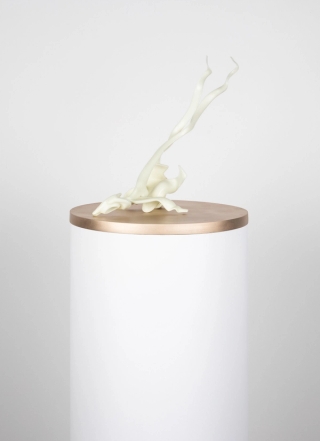
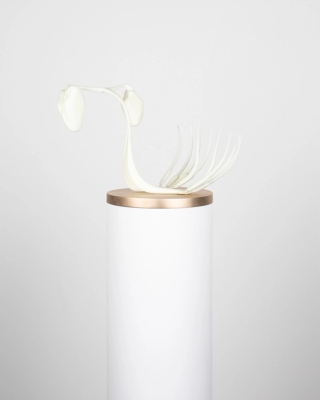
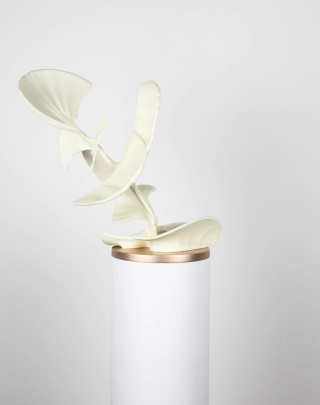
SG: They are almost like dioramas, in an abstracted form. They are miniature landscapes, created in complex combinations of materials and techniques. It seems to me they sit in an interesting space between science and séance. They look like models of climate forces or scientific instruments, but as you’ve said, they operate almost like a dowsing rod or a Ouija board, in that they’re reading or making visible invisible energies.
MH: I went recently to the Greenwich Observatory, and I was looking at all these beautiful chrome chronometers and different instruments. To me, the sculptures in ‘Dust’ connect to this kind of instrument. They’re scientific, but they’re also highly spiritual, in that we’re measuring time.
SG: That’s somehow implied by the form, because the knitted wires look like diagrams of spacetime nets. It looks like advanced physics, but at the same time, it’s almost like spirit photography or ectoplasm, or a supernatural emanation or even art historical depictions of spirituality – of being taken up to the heavens, or the visitation of the Holy Spirit.
MH: It was interesting because with ‘meys’ there was something quite bodily and grounded with the wax and the wood, and with ‘Dust’ it’s almost the opposite in terms of sculptural exercises. It’s about, how do you create the lightest... How do you represent smoke? Physically, I mean, it’s a challenge.
SG: It struck me that very often you are trying to do something with sculpture that is essentially contrary to the nature of sculpture. By this I mean against the idea that sculpture is still and unchanging. You’re often seeking to express something that’s a moment of transformation or that’s in process, that’s growing or decaying or showing things that are invisible. That’s a challenge.
MH: Maybe my mindset is that I don’t really think of them as sculpture, I think of them as living beings, so maybe that’s where the challenge comes from. But there’s also a huge sense of enjoyment in working through the materials with all the artisans we work with, and really understanding how we make this happen. I do a lot of research and for a long period of time what’s happening in the studio is conceptual, and then I feel there is always a great sense of pure joy to actually work through the different iterations and trying to get a material into a certain physical form. To push things to the limit and to understand how to resolve actual physical forms.
SG: Do you see a connection to some of the materials that you use, like glass or rubber, that exist in different states of matter?
MH: Definitely, because I feel that when you see a material in a specific condition or state, I think we can feel if it’s been liquid before, or if it has the potential to be liquid later on, or if it can soften. For example, with bronze, I think we all feel the fire somehow. It’s strange but it’s like if you look at wax, you feel a certain way, if you look at rubber, you feel a certain way. When you look at wood, we can all see that wood has many different forms we’ve seen.
SG: And that it had been living.
MH: So I believe that the materials have memory and intuition that we can feel through them, even though we can only see one state of them in the present moment.
SG: The other thing that I feel that you’ve achieved with the materials in ‘Dust’ is to embed the suggestion of death coexistent with life: entropy and decay as well as generation. It’s in the particles of matter that you’ve put into the glass of dead skins [2024], and that sculpture’s suggestion of shed skin or the dead material. It’s also in the way that the nets suggest a sort of skeletal form, perhaps the skeleton of a sea creature or the structure of a leaf.
MH: With dead skins I was interested in how we translate the feeling of decomposition and mould and putrefaction into glass, which I found interesting because glass is traditionally used for the exact opposite, for purity and clarity. The glass blower, Matteo Gonet, and I have been talking at length about the work of Leopold and Rudolf Blaschka, who in the 19th century made detailed glass models of plants and marine life, now in various museum collections. We were both interested to see how we could pursue this research to show aspects of life that are also part of the process of death.
The nets were inspired by some of the spiders I observed on the land of ‘Orisons’. I was thinking: What if the spiders were starting to knit the nets of time in which they’re embedded? In the studio, I have a collection of skeletal leaves and I studied them to understand how to recreate the organic feeling of a leaf growing and how the structure branches out, so that I could ensure that the nets seem to have grown from one single point. ‘Dust’ is a celebration of life on Earth, and this includes human artisanship. It involved several ceramicists, a glassblower, a knitter, stone carvers and so on, each of them trying to push their craft in ways that they hadn’t done before.
SG: A celebration of human creativity. To take that idea further, the little forms of the female figures and the cattle in the disappearance of the bird [2024] and cattleguard [2024] look like the very earliest sort of primitive art.
MH: I was interested to create smaller elements that almost felt like prehistoric cave paintings, but brought back to life as miniature, ceramic models. The reference is clear, and I left them in raw clay, but they are all based on digital models. For example, the cattle have been modelled in 3D from a cave painting, and then cast from the 3D model that’s been printed. So they look ancient but, paradoxically, they’re very high-tech.
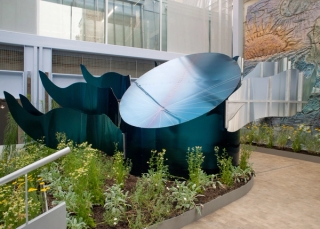
In a similar fashion, we gave the stone carver a 3D-printed model of a form that looked like wet, bubbling mud, and we asked him to carve this in onyx. I enjoy this contrast between using an ancient craft but also working with high-end technology and expressing something through a material which is its exact opposite. So making a piece of onyx feel like it’s wet mud that’s about to dilute itself. This, we also already explored a bit with ‘meys’; for example, all the wood pieces that were carved, both by hand and machine, after models of mud and roots melding. So, yes, this has been a direction in the past year.
SG: You talked about the experience of being in the desert, and the difference between what you see at first and what you see after spending time looking. You’ve brought something of that sense of shifting scale into the gallery through the photographic works, which show enormous vistas and also close focus on the details of nature. Another play of scale is in the miniaturisation of the landscape into the sculptures, which are in themselves the same scale as the small interventions that you made in ‘Orisons’. It’s an expansion and contraction in space, isn’t it?
MH: It’s interesting that some sculptures need to be 1:1. In relation to the sculptures of ‘meys’, for example, the sculptures in ‘Dust’ are really small. But because they’re so small, they become miniatures of much bigger worlds. Whereas maybe the sculptures of ‘meys’ have their own physical presence, so you wouldn’t imagine them at other scales. They are an embodied encounter with a presence that we can relate to, but still look up to.
SG: Whereas the sculptures in ‘Dust’ are like a whole world on a tabletop, which leads back to the idea that they act as a portal in space or in time. Their swirling, centrifugal forms call back to the circular plot of ‘Orisons’ itself, which, I think, could be a kind of mouth; those mythological places on Earth where one can pass between one world and the next.
You gave the show the title ‘Dust’, the name of the most humble and prosaic kind of matter, but a word that, for me, has biblical echoes from Genesis, ‘from dust ye came and to dust ye Shall return’, wording that’s also in the Christian funeral service. I remember you said at the beginning of our conversation, in talking about ‘Surface Horizon’, that it’s the place that life comes from, and it’s also the place that’s full of all the dead of the Earth. Is that right? You were thinking about dust as a place of life and death, I imagine.
MH: For the title of the show, yes, I was thinking about that. I was thinking about what the owner of the land, Rob Jones, told me: that all he cares about is dust. He meant that all he cares about is dirt, which actually means, all he cares about is the soil, because all he’s obsessed with in his life as a potato farmer is the soil, and the life in the soil.
SG: The soil is constantly blowing away, isn’t it. When you’re in the desert, you can see that the wind is carrying away the top layer and piling it up against the mountains.
MH: Which is very interesting because, yes, it’s quite an experience to see the soil blown away, whereas maybe in ‘Surface Horizon’, when I was thinking of the soil, I was thinking of a wet kind of soil, like a compost pile. With ‘Dust’, I was thinking of origin stories, of origins in many traditions around the world that tell how we are made from mud, including the Golem stories in Jewish folklore. I talked a lot with Ronald [Rael], the architect that did the bricks made of mud in ‘Orisons’, about what it meant for him, from the spiritual perspective, to build your home from mud. And I was thinking about this idea of particles, because I see the artworks in ‘Dust’ almost like clouds of particles. You know, when you’re a kid and you have these dots with numbers, and you draw the lines and you get a drawing.
SG: You make points in space.
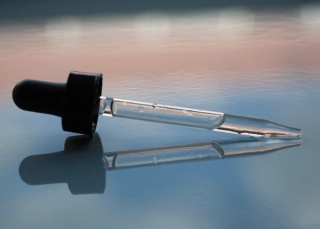
MH: Shae [Whitney] from DRAM Apothecary, who made the elixir, told me about this concept of the inhabited loneliness, where you feel lonely, not because you're lonely, but because you feel that you're part of an immense web of lives that you can't actually see. And you really feel in there with the stars and the burrows, you feel like you’re a tiny dot in a huge constellation, and that there are dots you will never see in your life, but you will always feel them somehow. So, I felt that the sculptures capture that feeling; clouds of dots that have crystallised to become these sculptures. But maybe tomorrow we’ll draw lines between other dots and create new sculptures.
First published in Marguerite Humeau ‘Auguries’
Published by White Cube, February 2025
.jpg?w=320&q=100&auto=format)
.jpg?w=320&q=100&auto=format)