A Conversation with Marguerite Humeau
Maura Thomas
From Sculpture Magazine, International Sculpture Center, Pittsburgh, US, 2023
Maura Thomas: What has the timeline been for Orisons?
Marguerite Humeau: We had our first call right before the pandemic, in January 2020. Cortney Stell, executive director and chief curator of Black Cube, contacted me, and she said she’d love to a project together. It was an open invitation—I could choose a site—so really like a carte blanche. Then the pandemic happened, and our conversation went a bit on pause. During that year I started to do a lot of research on weeds and the soil; this is how I came across these circles that are used for intensive agriculture in the United States and elsewhere—mostly desertic areas. I got back in touch with Cortney and said, “I’d like to find a circle of land that we could transform into an artwork.” That’s how it really started, which was January 2021. It’s going to be two and a half years since we started to look for land by the time we open the show, three and a half years since I was first called.
MT: Did you then work with Black Cube to find a suitable location?
MH: Black Cube found it. We identified different areas in Colorado where these circles are being used. Basically there are circles because they use what is called a pivot irrigation system. A central tower is connected to a well in the ground that usually pumps the water from the aquifer up to the irrigation system. Then, attached to the central tower, are usually eight to ten other towers that are all aligned and that circle around the central one. So it’s an irrigation line that’s supported by a series of towers that are on wheels, circling around this central tower.
They looked very hard everywhere across Colorado and ended up getting in touch with this farm called Jones Farms Organics, who said they had a fallow circle that they would be very happy for us to transform into an artwork. We are really lucky to work with them. It’s a fourth-generation family farm, and Michael and Sarah, who are now the owners, are taking care of everything. They have three daughters. We’ve been working hand in hand with them, specifically with Sarah, who has been following the project since day one.
MT: Was there a transition within the family from a more intensive way of farming to organics?
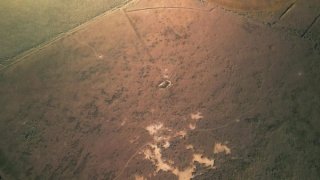
MH: The farm has been in Michael’s family for four generations. Before them, it was Michael’s parents, and before them, his grandparents. So there are traces on the fallow circle that is becoming the artwork. It’s really moving, actually, because you can see the ghosts of the past of this land. There is a concrete slab in the center, and you can also see a hole where the well used to be. When you look at the circle from satellite, on Google Earth, you can really tell that in some areas there was something spinning.
The real quest of Michael and Sarah has been to transform their farm into an organic farm, so they’ve been doing lots and lots of tests on how to revive the soils. The soil there is really hard—I mean, they’re working in very harsh conditions. It’s a desert, the highest alpine valley in the world, so there’s a lot of wind; it’s very, very cold in winter, it’s extremely hot in summer. Obviously also one of the reasons why I was interested in this area, and the San Luis Valley, is because it’s well known to be in the midst of a mega drought. The aquifer is getting emptied, and less and less rain is falling. To talk about that with them as well was quite emotional, to think about a future that may not look like what you had dreamt about for your family. Michael was showing us some diagrams on how he divides the circles now. In intensive agriculture—monoculture—the circle is all used to cultivate a single crop. He is really thinking about how he can divide the circle so that all the different plants actually help each other and regenerate the soil. He is rotating them every year, so that depending on the year, he’s planting different things each with a different effect on the soil. They’re a role model for people in similar situations.
They have a large farm, but this specific circle they were not using. When you drive to the land, you are on the main road, turn left, and there you see all the different circles. At the end you see Orisons—the artwork is the last circle before the land is not cultivated anymore and you reach the sand dunes. As you walk through the land, through the artwork, there are some very different moments. For example, in the northwest corner, you can really see and witness and feel the agricultural history of the land. Some areas are much more wild; for example in the southeast, between the center and southeast corner, there are these adobe patches that look like you are lost on some kind of alien planet. Not far from there I found the remnants of a skeleton—maybe a cow—that were dispersed. Again, quite moving, thinking about what had happened to this being, maybe dying alone in the desert. And then there are some other areas, like in the northeast corner, that are much more wild, where you’re directly connected to the park [Great Sand Dunes National Park] and to wilderness. As you walk, you sometimes fall into small burrows; there are lots of underground creatures living there. Also “overground” creatures: ant mounds, lots of weeds. It’s subtle and mystical, but very powerful. You can feel the wind’s really strong, and you’re there between the ground and the horizon line with the mountains in the back.
MT: Had you ever been to that area of the U.S. or in that kind of landscape before?
MH: I hadn’t actually. I had been to New York. Maybe that’s why it also had such a huge impact on me. It’s totally sublime. It feels like a sacred experience. Maybe for a French person like me, it’s very far from where I grew up and what has been familiar so far. It was a complete shock.
MT: How did you go about deciding what you were going to do with this huge amount of land?
MH: It was a long process. At the beginning I was thinking about Land Art, and we kept talking with Cortney and Hannah James, producer at Black Cube. How do you understand the scale, and how can you have an impact? Obviously, we all know the greatest pieces of Land Art that have ever existed, and I was really trying to understand how other artists have dealt with similar challenges in the past. At the beginning I developed 10, 15, maybe 20 different proposals. We even partnered with a landscape design agency called MKSK, who very kindly donated hours to help us with the project. I would send them ideas, and they would help me develop them into concrete proposals that could then be analyzed to understand feasibility.
We kept hitting walls. I went to install my work in Venice for the Biennale, so I had a bit of a break on the project for a couple of weeks, and when I came back I had a shift in my head where I thought, “Maybe I’ve been thinking about this upside down.” Today I don’t think it’s really about having an impact, like a visual impact or a physical impact on the landscape. It’s much more about a lighter touch. How do we celebrate what’s already here, and how can we do a project that would have a hugely meaningful impact on different human and non-human communities, but without having to physically create too much change? This was a real shift in my head, and when things really started to work on this specific proposal.
I thought, first of all, that the work is the land. What I will do as an artist is only going to celebrate or help or support or just care for what is already here. It’s not about leaving my trace or anything like that. First of all, we need to stop and look at it, and for that we need to be able to lie down. I thought, “Okay, maybe we just put benches.” How do I help humans stop and have a look and witness? This is a greater concept I’ve been thinking about this year, also for my show “meys” at White Cube. How do we become a collective? In Colorado, in the San Luis Valley on this piece of land, climate change has already hit—it’s extremely dry, and yet there are species living here with almost no water. They have adapted, they thrive. What do we learn from them? How could they be our guides to understand better where we should go, and how we should collaborate together to apprehend our own futures? I also thought of the cranes—there is a huge sandhill crane migration over Orisons, in late February and September. The cranes stop in the area during their migration, so they became really iconic birds; they’re also one of of the oldest living bird species in the world. It was also beautiful to discover that there are very ancient petroglyphs, drawings of cranes, in caves nearby in the mountains. You also see the birds in Indigenous cultures and mythologies around the world. There is the figure of the crane that flaps its wings to trigger the rain.
I was interested in linking, when I’m talking about living beings, not only the beings that are living there, but also maybe mythological beings that live in peoples’ imaginations, in our collective imaginaries. I imagined this giant crane—a family, so there are seven—that could be hovering above the land. They’re going to be 10 meters long, and each of the wings is like a hammock on which you can sit or lie down. For me it’s really about: How do we merge with the greater whole of life? In a way, we can talk about a post-climate world. Maybe we shouldn’t be so self-obsessed about our own extinction; maybe we should be caring for life because life will survive us. So that’s how it connected to the birds—how to be in this position where you belong to a collective that is maybe not only a human collective. In this case, we are invited to fly on the wings of these cranes, and become birds with them.
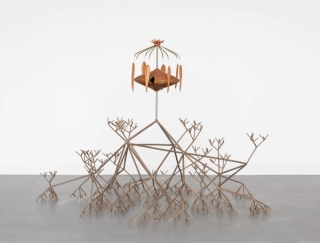
At the beginning I was thinking of creating some form of opera. When I was on the site of Orisons, I brought back some plants that I had foraged. I did lots of drawings, analyzed them, took some details, and tried to understand what each one was conveying. From there, we designed wind-activated instruments, each one inspired by a weed that I found on the site. For example, there was spurge that looked like it was dancing in the wind; Russian thistles rolling and flying. Each instrument is based on one of those plants that many people call invasive or non-desirable. For me it’s strange to call something invasive. Like seeds, they have no borders; they embody an idea of freedom. I’m making dozens of them. They’re really small, about 30 centimeters in height, so they have the height of the plants that are on the land. Like the cranes, they hover very low on the ground. Both the birds and the instruments are going to be metal because they need to resist the elements, but I’m working on a very specific finish that will look golden like the light there, and have a sort of iridescence. They don’t really look metallic,; they look more like they’re made of light. When you look at Orisons, they are almost completely invisible in the landscape, and it’s only as you come closer that you discover that they are there.
Finally, I’ve been talking to people with geomancy skills—who can read ley lines and energy lines—who gave me readings of the land. Some of them gave accounts of human communities that had tried to settle here but didn’t manage, and of deaths that occurred on the land. Lots of human communities passing by and leaving. For example, I was told that in the North West corner, around 1850 a group of humans, nomads, stopped here. They didn’t live here, it was too harsh. They were 6 humans, and the eldest female died here. The climate was too harsh. I was told she was trapped on the land and needed help to be set free. I am giving her my age: 36 flowers for her to be set free. In the South East corner, 700 or 800 years ago, maybe even back 1400 years Ancestral Puebloans traversed this place, they didn’t stay there long, they were experiencing the country, they could move energy with their thoughts, they came from a different dimension, their presence is felt here
I created a flock of sandhill cranes, some of them will invite you to lie on their wings and some of them will sing from the depth of the Earth.
I’ve been thinking that I could use the instruments almost like acupuncture needles, placing them in very specific areas that the geomancers told me had things that we needed to care for. I’m hoping that, like a tiny acupuncture needle, they’ll have a huge impact on what’s around them.
MT: Are the sculptures entirely kinetic or wind-activated, or are there electronics involved?
MH: There are no electronics, because we have no water, no electricity. For me, the beauty of this place is that we really had to collaborate with whoever or whatever was here. I thought, “Okay, we have the wind—the wind is going to be our greatest collaborator.” And so everything is wind-activated.
It was definitely challenging. You don’t really know how much wind there will be at any specific time. Some things will be spinning at high winds, but maybe not when humans are going to be there to experience them. In a way, I’m not designing these instruments for humans anyway. I’m designing them to give them to the land. I always felt like I was a guest on the land, and that we are making these acts of care for the land to reconnect with itself—with its past, with its future, with its parallel presents.
MT: You created drawings parallel to the development of the project. How do they relate to it, and to your practice in general? These are more abstract, but in the past you’ve also done diagrammatic works.
MH: Over the years I’ve developed different types of drawings. The first series were more like diagrams, trying to understand how things connect in time and space: to connect the deep past with the far futures and maybe the parallel presents, and to understand the cycles of lives and deaths and the connection between bodies and souls, and ideas around transcendence. These were ink on paper, and then I developed a new series, between mid-2021 and the end of 2022, that were in pastel. I was using a mix of color pigments and charcoal, and originally they started as I was working on the show “Surface Horizon” at Lafayette Anticipations in Paris. I was collaborating with a clairvoyant person—that’s connected now to collaborating with geomancers for Orisons. I believe there are humans in the world who have specific skills and gifts that maybe have never been recognized but could be key to our understanding of the world, our guides to understand where we are going. I felt the pastel drawings were almost a form of divination—the clairvoyant person was telling me you can use cards, like tarot cards, for cartomancy, for example—so I was developing this idea of doing cartomancy but with drawings. I started to paint visions into the soil; I was also working with images made by AI and other kinds of non-human beings and reinterpreting them. That specific show was about the soil and the “surface horizon,” which is the layer of soil with the most living beings and decaying organic matter. That’s where I think some of the most important transformative processes happen. I was thinking about this layer of the soil almost as a mythological space where we could start to understand how to connect. What do we learn from roots?
I started to think about the drawings almost as elixirs—again, thinking about artworks that could be active agents. If it were an elixir, how would it look? I also studied the theory of signatures, which is an ancestral theory that links the form of plants with human body parts. It’s like a decoder into the natural world. Using this theory, I was painting plants, translating them almost into extracts—thinking about drawings or paintings as extracts that you can ingest and that will maybe have some form of transformative power over you.
More recently, I’ve been doing what I’m calling the “Ghost Maps.” After my second site visit on Orisons, I had this huge desire to try to map everything and everyone whose presence I had felt on the site: from the animals to the plants to the wind to the weather conditions to mythological birds and to future birds and to rain patterns and to the pivot irrigation system and all the histories that I had heard about. I was thinking about spectrograms and spirit photography, and obviously I was thinking about water, which is missing. I started to make water-based drawings that act as a dance to make a map, but a fluid form of map because things are in constant movement anyway—it’s trying to convey that feeling. That’s where I’m at with drawing and painting: one series emerges from the previous one and keeps evolving, so let’s see where it leads me.
MT: Can you talk about the Dall-E imagery in “meys,” your recent show at White Cube?
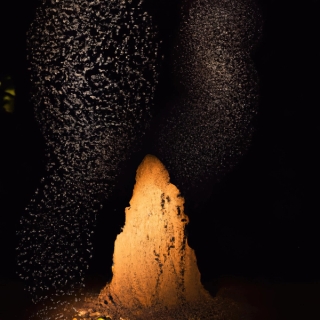
MH: I asked Dall-E to help me imagine a world where termites perform some form of early dance ritual. I’ve been looking into collectives and eusocial insects—bees and termites, for example—and looking at what their glue is, their social bond. Some termites are symbiotic with a fungi called Termitomyces. I’m trying to understand what our fungi is as humans—it could be yeast and maybe beer because early communities are thought to have discovered fermentation early on. The moving image explores that: what happens at the birth of a termite mound, and looking at images that are almost scientific but maybe from a world that hasn’t quite developed or that we haven’t yet discovered.
MT: The termites’ dance is sort of joyous but also a little scary, like a danse macabre.
MH: That’s what I felt, too. There is something a bit comical about it, but also dark. I’ve been generating lots of images with Dall-E, and I was thinking about my sculptural work, how at times I’ve been animating—giving life to—my sculptures so they become beings through sound. I want to do the same with these images: by giving still images just a bit of movement, in a way I’m bringing them back to life. It connects back to reanimating the dead, and a fight against extinction. It’s also exciting because they have been generated by an AI, and now as humans we are trying to craft them back into something that’s alive. That’s also something weird in the process, I find—weird in a good way.
MT: You recently visited Prospect Cottage, Derek Jarman’s house in Dungeness. I don’t know if it was connected explicitly to Orisons, but I wonder if you thought of connections between the two.
MH: It’s connected for sure with Jarman’s garden—his garden feels like it emerges from the landscape. There’s no boundary between them; it’s all one thing. I had never connected back to the project, so I’m very happy that you are.
You can feel in the garden that he’s really been living there. There is a lot of care. That’s the feeling that really stuck with me: that you feel a lot of care and love for his surroundings. And it’s a really light touch, just almost slightly forming the landscape into something else. It’s like a mirage in a way, a distortion—it’s not an addition. Clearly, I feel totally aligned to that, and it’s had a huge impact on me, like it has for many people.
_Traces_of_machinery_observed_from_satellites_Other_traces_of_unidentified_presences_2022_Image_credit_©_White_Cube_(Theo_Christelis).jpg?w=320&q=100&auto=format)
.jpg?w=320&q=100&auto=format)
.jpg?w=320&q=100&auto=format)
.jpg?w=320&q=100&auto=format)
.jpg?w=320&q=100&auto=format)


