A Conversation with Cortney Lane Stell and Marguerite Humeau
Cortney Lane Stell
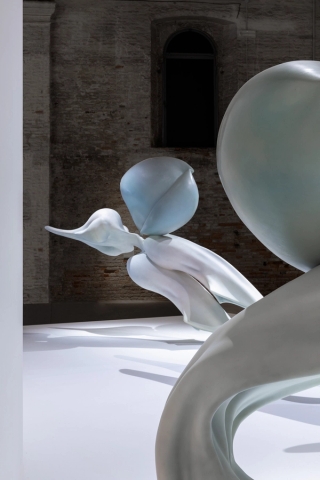
From CURA. 39, Are We Eternal Beings?, Rome, IT, 2022
Cortney Lane Stell: We have been on such a wild ride over the past few years. When you first agreed to do a site-specific project with Black Cube, you were in a very busy place in your career, which has only gotten busier. In the time we have been developing our project together, you have joined White Cube, participated in the 59th Venice Biennale, and much more. It’s been nice to see concurrent material and conceptual shifts in your practice; for example, items like plants and clairvoyants have entered your practice. The project we are working on together has stretched your practice in new and different ways, as well as expanded my curatorial practice. Let’s start with addressing these shifts. Where are you in your research at the moment? What is being composted? What is being made anew? And what remains as a throughline in your work?
Marguerite Humeau: I have been through some major shifts in my work in the past two years, as we have been developing Orisons together.
Until 2019, I was (re)creating mythical ecosystems that were internalized, evolving in their own world, with their own logic. I have always been interested in exploring how these supernatural ecosystems could be experienced physically through voices, sculpture, and environments. I have been interested in exposing humans to these other worlds. My exhibitions were like portals to access them, like almost flickering glimpses. I was interested in presenting an accelerated view of life to the point that death is erased, similarly to the ancient fascination for eternal life. My aim was revealing the dazzling horror of “life without death.”
At the end of 2019, I was feeling that the next step for me was for all the components of my work to become active agents of change, transformation, connection. The Earth is on fire, and we are trapped on it. I became obsessed with exploring parallel worlds such as the soil beneath our feet or the weeds growing on the side of the pavement, looking at worlds or beings that may have gone extinct for us mentally but that are physically very much alive. For example, a lot of plants that are considered to be weeds nowadays contain substances that can heal, support, and care for other organisms. They can also act as oracles and tell us about the future: for instance, some weeds only grow on lands that have been eroded or have become too acidic and are about to become desertic. I began to consider the creatures that inhabit the soil, asking how they could be our guides.
I entered an 18-month period of intense thinking about weeds and soil horizons. Surface Horizon at Lafayette Anticipations was for me the (first) physical manifestation of this new research. This show was conceived as a garden, the works in the ecosystems introduced my practice to transformation, change, and vulnerability. The plants in the installation evolved with time, some grew, and others died, only to be reborn under various forms and even animals came to inhabit the landscape. The pavilions were also agents of transformation for the humans who penetrated them, connecting them to oracles, to their own futures and their own past (with the help of the clairvoyant who was also inhabiting the show). The sculptures within the installation acted as elixirs, injecting themselves into the visitors’ imaginations. Even the pastel drawings were used as “mancies” by the clairvoyant who was traveling through space—like cartomancy, but with my drawings. I focused on (re)integrating the human in these ecosystems as a way to re-invent the relationship and consider how we humans fit in on Earth today.
I am still rethinking the role of mythology as an active agent in our lives. I am dedicated to exploring the great mysteries of human existence from our origins and our ends; to diving into the essence of life and that of death, to wondering about how souls travel. I have a renewed dedication to celebrating the marginal beings that are extinct, living on the edges, considered invasive, fragile, or vulnerable. Calling on the ghosts of our existences. A quest for understanding what presence is. A dedication to thorough research that includes vast communities of experts in various domains, and even more than ever to connect with humans who hold skills or bodies of knowledge that have not necessarily been heard or made it to official written records. What remains is also a great appetite to find materials, sound waves, and forms, that translate the mystery of the living, and render the ambiguity of flickering visions.
CLS: In your practice, you continue to be a visual storyteller and world-maker. Many of your projects involve a combination of extensive research and deep imagining that merge fact, speculation, and aesthetic formalism. In blending histories, present conditions, and poetics, you create art experiences that connect us to wider perspectives and broad, nonlinear space. Given this layered relationship you have to artmaking, I’d love to help readers delve into your world. Can you guide us into this space by describing one of these ecosystems you have manufactured? What does your work evoke? What do visitors see, feel, or experience?
MH: A long and epic walk through… it is one continuous fluid story with many portals… hearing the resuscitated chants of prehistoric creatures, feeling their physical presence, their monumental bodies, their vibratory bodies. Seeing them appearing as ghosts. Feeling your fingers vibrate softly as you touch their vocal cords. Feeling their ancient presence and feeling close to them. Feeling the horror of it all, entering a portal of space and time. Being in deep time and coming back to tomorrow. Being exhilarated and wanting to stay longer. Hearing them evolve, synthetically, majestically. The horror of an ancient creature having its own agency in your world. Supernatural presences.
… listening to Cleopatra singing, whispering in your ear languages that no one on Earth remembers. Listening to her presence, sensing her aura, hearing her chanting to someone that she used to love. Feeling seduced but also terrified—she does not have a body. Her presence intense and hollow, at the same time. An empty shell, the immense void of a being who can only be heard but never seen… lost in an immaterial, digital world, where everyone is a soul-only, an escaping presence.
… stepping into a glowing, ultra-bright almost fluorescent yellow room. The seemingly infinite space does not have walls nor corners. The yellow is black mamba venom, don’t lick it, don’t touch it, you should not even be here walking on it. Feeling intensely alive and in a death bath, simultaneously. In the liquified body of a deadly presence, feeling naked and vulnerable.
… witnessing Egyptian gods who have become animal-products in a production line, they are producing an elixir of life, life intensified, how horrific life can be when death has been annihilated—this may be a luminous form of horror.
… following an (invisible) early human, maybe Lucy, singing her way through the birth of… some form of language, she sings the rain, the forest and the birds, eventually, she becomes… human? She is vulnerable and fragile, and her journey is chaotic.
… hearing all the hundred and seventeen billion humans who have ever been born on Earth since the beginning of humankind all sing together from (…)?
… stepping into a world in which elephants and not humans have evolved… entering a large bright showroom of ideas and prototypes for what these beings may feel like… being invited to a face to face, entering in dialogue with their alienness. One of them, their matriarch, is dying and we are intruders in what seems to be an intimate moment. Feeling their shock and sadness, feeling their loss, feeling their despair, the void that their mother’s passing leaves in the family. Hearing her ancestral heartbeat slowing down and down until it stops. Feeling entranced and horrified by the scene. In deep time, in a parallel present, in a possible future.
… hearing the FOXP2 gene mutate… clicks…
… entering a dark room in which a group of early women are reenacting the origin of consciousness through a singing trance-like state. Lying down next to their warm bodies on soft, dark grey mattresses. Looking at them being sacred and bodily. Feeling the brain of humankind rewiring in this primal, original trance… imagining the possibilities that this opens.
… witnessing a large marine mammal dying at sea, witnessing their breath stop, watching their body changing colors as it becomes a corpse, seeing their last attempts to reach transcendence and hearing their soul circling around you. Entering the exact same room, the body has disappeared. Witnessing the same situation through the account of a young poet, who describes to you the exact sensations and visions that you just experienced. Wondering where this happened? Maybe only in your imagination… mental extinctions… mental creations.
… witnessing marine mammals dancing to the moon, they are made of pure flesh and raw muscles, they are naked to the oceans, witnessing a school of fish attempting to breathe life back into one of their dead through a sophisticated synchronized breathing dance, witnessing their despair, and their mystical energy.
… walking through a vegetal ocean, realizing each flower looks like a human body part, swimming through it and wondering what this may mean, feeling transported, and nauseous.
… entering the vision of a desert and meeting its oracles… feeling hot, feeling blind, entering a crystal ball, meeting a clairvoyant, thinking you are looking at the soil but realizing you are looking inside yourself, asking yourself, what lies dormant? Crying.
… drinking sculpture elixirs. Feeling the intense heat on the skin of a sleeping person, as if all their secret delusions were becoming vapor. Thinking about a relationship that you can’t get out of your head, that is still somehow alive, unfinished. Feeling intensely once again.
… entering in the darkness of the soil, and witnessing visions of all the microscopic, magical interactions that happen in it, witnessing sparks of communication, ants and termites working together as a single entity, witnessing energy flows, witnessing decay, decomposing organic residue, eggs, earthworms and their channels, aerated soils, webs of magnificent fungi, UV radiations, warmth, nitrogen fixation, dead birds, dormant seeds, acidic soils, equilibrium, fluorescent powder of infinite potentials… witnessing the origin of lives and all of its tilting points.
… realizing what we have lost.
… witnessing the exact second of cross-pollination of a microscopic grapevine flower becoming a hermaphrodite.
… meeting the spirits, the guardians of our towers, feeling their protective flows around us, feeling safe.
… drinking another elixir, bright, red and bubbly, a concoction for the heart, not being sure what exactly it will do to you; however, feeling that you belong, maybe more, being part of a group, being part of the group, of the greater flow of life.
CLS: You describe sensations of bliss and horror, both phantasmagoric and real. This makes me think of how modern specializations have pulled us away from viewing both the wholeness and interrelatedness of our world. Your work seems to occupy this space that connects, remixes, and fuses territories often seen as separate from one another. By gliding into territories in which you have no specialization, from appropriating the form of the opera to expounding on anthropological research, you make broad connections. Your work also probes the ecstasies of surrealism by delving into mysticism and poetics. You welcome in fringe thinkers who have been cast out of the mainstream occidental culture. You seem to work from your own primordial soup, like a DJ, an explorer, or a storyteller, you weave together experiences that speak of something timeless, guttural, and vivid. Can you speak about this ecosystem that you build to produce your works? What comes first, research or inspiration? How can we better understand the way that you bend time, connect disciplines, and evoke deep instinctual emotions?
MH: A DJ of deep times and extinct knowledge! I am not sure what comes first… life, maybe travel, or constant thinking? Recently, I have done a lot of “open” research trips: research with no specific goal, just an open mind. I have been visiting places where I thought I could find myths embedded in the land, in hopes of better understanding the power of the collective and of synchronization, in humans and all life forms.
At the end of 2020, my partner and I went to Crete. Where we landed happened to be a UNESCO global geological park, and there I found angels, dinosaur eggs, running spirits in monumental rock formations… There were crystallized thunderstorms, solar panels moving their head to the sunset, wounded goats rubbing themselves into medicinal weeds.
This past summer, we spent two months in the Australian bush, up between the Northern Territory and the northern part of Western Australia. There, we slept in the bush in the open air under the suspended stars, and I was grateful to physically walk through mythological and sacred landscapes, rocks, rivers, waterfalls, and termite mounds. When I travel, I usually find a key and then focus my trip on unfolding this key in various ways. In the bush, the termites gave me access to a deeper understanding about what it means to act together as a group to build habitats, sacred figures, living structures that are in complete symbiosis with their environment. I think termites might be the key to the origin in spirituality and sacred rituals in animals and can teach us many things about cooperation and survival on Earth. I was listening to the audiobook The Soul of the White Ant by Eugène Marais in the truck and all of this laid the humus for my upcoming show at White Cube in London opening April 2023.
So yes, it starts with research, and inspiration, and coincidental encounters, and music, and also my personal life. I am hypersensitive, so everything around me feels really amplified. This can be overwhelming most of the time, but my hypersensitivity also gives me a strong sense about what to explore, viscerally. My sensitivities may connect me to what the rest of the group is feeling. I press feelings like flowers to extract their essence, and then when I think I have found the essence of the feeling I can try to find some patterns as to how those feelings have translated through forms in the history of humankind.
I also pull together teams of experts who can help me recreate this feeling into a global myth for our contemporary era. When I say “experts,” I am referring to different communities. I connect mostly with people who hold unofficial, unwritten forms of knowledge: humans who can speak extinct languages, who forage for food and medicine and can heal bodies and minds, who can help us retrieve extinct emotions, humans who can read stories into the stars and clairvoyants who can see through the past and the future… I also still connect with scientists who I consult with on speculative, alternative possibilities for our own existence or other forms of existence. I ask them to come into the unknown with me. My partner is a scientist specializing in AI and quantum computing and how they connect to spirituality. He also sends me a lot of articles to read… and we discuss… and I draw webs and diagrams to discover how everything connects. I also study plants, and have a collection of seeds and seed heads, and have an herbarium of emotions, and I study comparative mythology… everything, in my life, gets into the brew.
For Orisons, a similar process occurred. Together, with you and Hannah at Black Cube, we talked to so many different people and communities in Colorado’s San Luis Valley and beyond… It has been a journey of conversations, connecting world views… and getting them to collaborate. We got to learn about local mythologies, traditions and stories, and rainmaking rituals. We met crane specialists like Rachel, who told us about crane culture and their sense of spirituality and connectedness, how they mate for life and connect and dance with each other. We visited the Monte Vista National Wildlife Refuge, and we met soil conservation scientists from the US Department of Agriculture, Natural Resources Conservation Service who shared a custom soil resource report of our land. We collaborated and conversed with teams of landscape designers and architects, botanists, adobe specialists, and local farmers who also shared their fears of the future and what they are dreaming about, we talked to a specialist of static compost in the area, to companies producing pivot irrigation systems, to someone else specialized in biodynamic principles, to foragers, and now, to sound engineers specialized in acoustic mirrors to be able to create our roaming spirits… and the journey is still unfolding.
CLS: We met in early 2020, when I reached out to you via a “cold call” (one of my favorite ways to connect with artists… no introductions, no connections, just a knock on the door). The organization I direct, Black Cube, produces site-specific and site-relational artwork in the U.S. and beyond. It’s a curious thing to agree to a Black Cube project because we start with an idea, a small pot of money, and our own wild ambitions. Now, after two and a half years, we are producing a 160-acre artwork (the size of a standard agricultural crop circle) in a rural farming community in Colorado’s San Luis Valley. Can you introduce Orisons, the monumental sculptural opera that we are producing together?
MH: It is really wild what we have been through together! It starts with a knock on the door, all you need is ambition and the desire to break through boundaries. The hardest thing to overcome are mental boundaries, but material ones can be pretty challenging too. Orisons has been such a journey and is the first major crystallization of all the recent shifts that I described earlier.
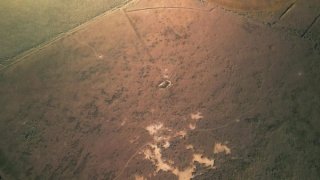
Orisons is a proposal to activate a piece of land for it to become an opera that recreates the sound of an ancient rainstorm. The 160-acre plot of land is a fallow crop circle that was once farmed using a pivot irrigation system for the purpose of intensive agriculture. It is around 800m in diameter, and the circle is contained into a square parcel of land.
The project is an attempt to recreate the sound or sensations of a rainstorm—a phenomenon that has obviously become almost extinct in the area due to severe drought. It is a quest to create a sound mirage that delivers the community’s need for precipitation, like an offering for the land, for the local communities of humans, animals and plants; physical, mythological, past, present, and future.
In this installation, people are invited to be part of a flock of birds, by lying down in large hammock sculptures inspired by the sandhill cranes and various local rainmaking mythological birds (including the thunderbird) “flying” low above the land.
The opera is composed of plants (all inspired by so-called “invasive” weeds found on site), and sandhill cranes, that have all transformed themselves into musical instruments entirely activated by the wind. The plant-instruments produce symphonies of raindrop sounds and the sandhill-crane-flutes produce long haunting whistles. They all echo into chambers, parabolic disks spread across the land, that further help for the sounds to travel through the land, like roaming spirits.
Lying in the sculptural hammocks, humans can listen to the opera or simply meditate in this transcendental landscape. The artwork is experienced from the point of view of being an insider in the flock of birds. From a human perspective, space and time merge in the work. As the opera is activated by the wind, the composition unfolds not in time but as you walk through the land. The map of the land becomes a music notation. The opera has its own agency, timings, and flow.
CLS: In many ways, Orisons is a different approach to land art. Not only is it about an engagement with the active agents in the area, from the wind to the people, but it also transcends the traditional physical experience with the landscape. How do you feel you are engaging this genre of artmaking?
MH: A lot of land artworks have historically been about leaving a trace that can be seen from the sky. Orisons is about leaving the lightest trace, one that is almost invisible, a caress for the purpose of reanimation. It proposes to transform a site of extraction into a site for transcendence. Orisons is the portal to our post-climate world, a celebration of the lives, physical or mythological, that may go extinct (the thunderbird) or no longer migrate through the area because of the change in climate (the sandhill cranes), or have been overlooked (the so-called “invasive” weeds such as the Russian thistle). I am interested in considering how these elements could be our guides to adapt to this new world. Orisons is about creating a work that enables beings from the historical and mythological past, the present, and the future to co-exist and guide us humans. The landscape reveals itself and its own ghosts through the work and offers them to us as companions. Orisons is about ensuring the continuity of love, unity, and hope through communion. It is about celebrating our acceptance to the larger flows of life. It is about being invaded by a feeling or a sensation (that of the sound of a rainstorm) that we have lost and will never experience again. It is about letting this ghost invade you and surrendering to it to better mourn it.
CLS: Our world is changing, our climate is changing, and it’s difficult to really comprehend the impact at times. But with Orisons, climate change confronts us head-on, again and again. In fact, the extreme weather of Colorado’s San Luis Valley, the world’s highest alpine valley, has been a challenge for this project and, more significantly, a challenge for the surrounding farming community. Can you explain how you approached confronting the changing climate in this work?
MH: The changing climate has been the main inevitable actor in this project… literally and conceptually.
The first proposal I developed envisioned a repurposed pivot irrigation system transformed into a rainmaking device dancing to call for rain. Such systems are pieces of equipment that rotate around a pivot with sprinklers watering the crops, allowing for a circular area centered around the pivot to be irrigated. They have been widely used in intensive agriculture. Today in Colorado, the aquifers from which they were pumping to water crops are vastly depleted. So, I kept thinking, there is no more water, no more water… no water… no more water… no more rain… how do we transform this land into a mirage, a water-retaining landscape, or even a rainmaking device?
I became obsessed to (re)create a creation myth for the San Luis Valley in our times of climate transition. I looked into local rainmaking rituals, and stories of thunderbirds flapping their wings to trigger thunderstorms. I looked into rainmaking costumes, feathers, turquoise stones, I looked into weather and mythological birds. I explored the sandhill cranes and their migrations. The spring arrival of the cranes in the valley seems to have been a rite of passage for countless generations. They are associated with the rebirth of nature in spring and with the rain. I researched into the history of the valley, and learnt more about the Utes, the first human communities inhabiting the valley. I researched zigzag patterns, I researched rain singing, and the 12,000-year-old sandhill crane petroglyph on the nearby Dog Mountain. I researched weather-predicting satellites at NOAA (National Oceanic and Atmospheric Administration) in Boulder, who amongst other activities are responsible for daily weather (and therefore… rain) forecasts.
The second proposal revolved around a pivot irrigation system that would have been reborn in the shape of a monumental sandhill crane calling for water and retaining it. I imagined the crane to be in rammed earth and to contain seeds to feed the cranes. In turn, I was hoping they would also contribute to the natural regeneration of plants on the site. The crane would have also been equipped with a communication system, directly connected to the satellites and weather-predicting AI models of NOAA. When rain would have been predicted by these models, a large red crystal ball-like light (a red sun predicts rain) would have started to shine, as if the crane-landscape was awakening as the rain is about to fall.
Then, I went for my first site visit together with Black Cube. It was really moving for me to be able to talk to the farmers of Jones Farms Organics, Michael and Sarah Jones. They discussed with us their doubts about the future, and the possibility to even live and farm here if the drought or absence of water persists. This discussion made me realize that our land for Orisons was a portal to a future that had already happened here, and I wanted the artwork to feel like an elixir for the local community, a mirage that would bring the community one of the things that they might desire most: water.
My vision shifted at that time towards being able to physically retain the water on the land. We started working with the MKSK landscape architecture firm, who also helped develop the following ideas.
After the site visit, I imagined a large structure built with snow-fences that would collaborate with the wind by guiding snow to fall in a certain way (like snow fences do in the valley), to help the land retain more water. From above, the structure would have looked like a large water drop. I was imagining that this monumental drop of water could be the first that ever fell in the valley, or the last.
We then researched mosaics, and how we could use a traditional craft to cover the snow fences. Maybe they could be glittering panels, recreating the vision of a sparkling water surface in the sun? We researched how water has traditionally been represented in the history of mosaics…
We also explored how to create those structures entirely in earth by excavating and recreating berms at the scale of the land, like an earthen-water surface with waves. I wanted to engineer each wave/berm to act as a snow fence barrier. Many questions were raised, such as how much carbon dioxide this would release into the atmosphere…! We then imagined how the waves might be done in adobe bricks, widely used in constructions in the valley.
I then imagined how the monumental water drop structure could be created with a multitude of painted glass panels, recreating the sensation of a water surface while also acting as snow fences, also collaborating with the wind. After developing the idea and testing it again with the local community, it became very clear that these panels would have been disastrous for wildlife, with deer and other animals possibly running into them: this was just one amongst many other challenging questions that we had to ask ourselves at this stage.
To create something that has a positive impact means considering everything and more. Negotiating with all the possible other impacts of the work, visible or invisible, impacts on the environment, on ecosystems, on relationships, on politics, on culture, on work, on infrastructures, and so on. The land is 160 acres. Any concept developed at the scale of this land posed a high number of challenging issues. From an environmental point of view, how do we make a work that is non-disruptive for the soil and its inhabitants, for the plants, for the wildlife, and any living being there? How to make sure we include, consider and care for every living being in the land? From a technical and budgetary point of view, how do we make a work at this scale? What does it involve, how do we source the necessary equipment in the valley? How do we deal with the extreme weather, the extreme winds, and the scale of the land? From an artistic point of view, what does it really mean to have an impact, and how to do this at this scale?
I “went back” (intellectually) to the land. Hadn’t we gone too far? I will always remember the feeling I had when I first visited the land, the valley, the horizon, the infinite sky. The golden light… the flying seeds and tumbleweeds. And then I thought, by simply naming the land Orisons, we are caring for it, giving it attention. The land and all living beings on/in it are the artwork, and all we have to do is helping them to express themselves. Maybe this is the only viable artistic gesture in our times? I thought about how it would feel for us humans to truly merge into the biosphere, spiritually, conceptually, to celebrate the persistence of life as a whole, to celebrate the lives on this land that had already adapted to our post-climate world… such as all the weeds (most of them labeled as “invasive”) that are surviving here in this extreme climate… are they not the heroes of our times? Vulnerable, nomadic, yet hyper local? Could we create a piece of land art that would be invisible? Not seen from the sky? Not seen—only visible to the souls who would pay attention. We are going through a constant near-death experience; the blindness is leaving us distraught. If we can’t see… maybe we can hear? What have we lost, should we be celebrating the beings that have resisted, that have adapted, that are resilient, and what do we harvest from catastrophes? Could we recreate a rainstorm, in the form of an opera, that would be dancing in waves through the land? How can an artwork enable transformation rather than impose it?