Surreal Femininity: Nature and “Woman” in the Art of Marguerite Humeau
Margaryta Golovchenko
From Journal of Posthumanism, Vol. 1 No. 2, Transnational Press, London, UK, 2021
Abstract
This paper focuses on the work of contemporary French artist Marguerite Humeau, specifically her 2018-19 exhibition “Birth Canal” and her 2016-17 exhibition “FOXP2.” Building on Surrealism’s interest in subverting the viewer’s notion of the real, the two exhibitions expand and reimagine the relationship between Woman, Nature, and the automaton. Humeau’s work makes the viewer question their understanding of gender, particularly whether behaviours that are codified as “female” in humans can easily be transposed onto the mechanical and the natural worlds. While the physical sculptures push the boundary between living and non, organic and mechanical, sound also plays an integral role in Humeau’s work by serving as the sculptures’ “voice.” In doing so, Humeau allows the nonhuman body to speak for itself, thereby undermining the Romantic notion of Nature as a sublime but passive muse.
Keywords: Animal Studies; Ecology; Sculpture; Sound Art; Surrealism
She could pass for beautiful if her eyes were not lacking any spark of life or, I might even say, of vision itself. She walks in a peculiarly measured way, every movement she makes seems governed by the operation of a clockwork motor.
— E.T.A. Hoffmann, The Sandman
In his first Manifestoes of Surrealism from 1924, Andre Breton names “romantic ruins” and “modern mannequins” as two prominent examples of “the marvelous”, a concept that referred to the extraordinary, “a temporal experience of timelessness” (Suechun Cheng, & Richardson, 2016, 242). Although Breton makes no explicit mention of the female body, and more importantly the notion of a “female essence,” it is also arguably a form of “the marvellous” that should be considered on-par with romantic ruins and modern mannequins. Although each of these three categories maintained a distinct separation from the others for the historical Surrealists, what unified them was their ability to expand what the Surrealists considered to be the conservative and straightjacketed perception of reality. The work of contemporary French artist Marguerite Humeau builds on Surrealism’s legacy in offering viewers alternative versions of reality that are framed as outcomes of ecological evolutions different from those we know. In Humeau’s oeuvre, the female body, romance ruins, and modern mannequins are updated into the more modern concepts of “Woman”, “Nature,” and “automaton” that work together in a triangular relationship. Humeau uses these concepts, as well as “the marvellous,” to question our inherent ideas of gender and corporeality when it comes to how we understand the separation between the human and the non, challenging the anthropocentric view of the world that has persisted from the time of Surrealism’s origins until today.
Automated Bodies: Depicting the Female Form
To understand how Humeau uses and even merges the natural and the artificial within the form of the female body, thereby complicating our definition of “woman,” it is necessary to begin by considering how Humeau’s work fits into the familiar relationship between woman and automaton. E.T.A. Hoffmann’s The Sandman is one of the best-known precedents for this as it set the foundation not only for the literal mechanization of the female body but also for the paranoia that patriarchal society experiences towards the feminine. Hoffmann captures a paradoxical and inescapable situation in which the feminine always comes out as the villain. On one hand, “Woman” is insufficient and imperfect, as Nathanael’s discontent with Clara reveals. On the other hand, the seemingly “perfect woman”, who is embodied by Olimpia, proves equally unsuitable because the perfection that supposedly fixed all of Clara’s shortcomings creates a disturbing uncanniness and results in a newfound demand for imperfection, even frivolity, for one’s “beloved […] dance and sing slightly out of tune, and that she should embroider, knit or play with a little pug dog while [one] read[s] to her, etc” (Hoffmann, 2014, 67-68).
A literal recreation of the female body in the form of an automaton is not necessary for the feminine to be demonized as something lesser, as Hal Foster (1993) points out that, “as soon as they are coded as demonic, [mechanical figures] are also gendered as female”, while the “patriarchal apprehension [that] greet[ed] the commodity, indeed mass culture generally, throughout the nineteenth century […was] also associated with women” (134). It is not within the scope of this paper to consider the paradoxical nature of this situation, considering that Nature has long been associated with women and fertility, as in the familiar “Mother Earth” trope, whereas the Industrial Revolution of the nineteenth century and the emergence of commercial culture seem to have reversed the situation so that the artificial has now become codified as the female. It will suffice to say that the legacy that Surrealism inherited in the 1920s formed a closed loop in which Woman—capitalized “to reinforce a sense of [the term’s] deceptive artificiality” (Morton, 2013, 43)—is always to blame, regardless of whether she is present mimetically or only invoked through a connotative approach.
Marcel Duchamp’s infamous The Bride Stripped Bare by her Bachelors, Even (1915-23) is one of the most prominent examples of the automated female body, considering Duchamp (1989) himself described “[t]he Bride [as] basically a motor […] which transmits her timid-power […] a sort of automobiline, love gasoline” (42). Stripped down to the rudimentary components until her form is no more than a suggestion of its functionality and mobile capabilities, Duchamp’s bride is a literal commodity since all the components in his piece are easily replaceable. In “engineering” a new human body, Duchamp also engineers a new “humanity”, building on the Dada movement’s interest in mechanization as a way of countering the increased rationalism in the years leading up to the first World War. The Bride Stripped Bare by Her Bachelors, Even is a variation of what Timothy Morton (2017) sees as the problem of perceiving the nonhuman in Marxist tradition, since “[t]o encounter the nonhuman within capitalism is to have been stripped of one’s human uniqueness” (33) except here the question is less about value and efficiency and more about the stripping away of all the complexities and ambiguities that go into the construction of gender in order to reach the core of what is supposedly “female”, a question that will be discussed later in the paper in regards to the problem of Essentialism.
The work of the German Surrealist artist Hans Bellmer, meanwhile, exists in opposition to Duchamp’s, for while the latter posits the human body-as-machine, rendering the human form unrecognizable, Bellmer literally dismantles it. Taking direct inspiration from Hoffmann, Bellmer’s poupeé, or “dolls”, are female mannequins that Bellmer photographs in a variety of poses and states of dismemberment and “represent a shattering – of the female object […] but also of the male subject” (Foster, 1993, 107). Despite the clear sadistic and masochistic implications of Bellmer’s poupeés, the first of which he constructed in 1933, the mannequin is one of the most propitious ways of producing “the marvellous” due to how readily it invokes a sense of uncanniness. Whereas Duchamp’s bride must first be identified as female before being read as such, thus making it unlikely that the viewer will confuse her for a real bride, Bellmer’s dolls force the viewer to pause and question, if even for a split second, whether what they are seeing is the human female form or its lifelike depiction, their uniform appearance further adding to the unease by invoking a feeling of déjà vu.
One will not find a straightforward depiction of the automaton, nor of the-female-as-machine, in Humeau’s oeuvre. Humeau’s engagement with automatism is less rootedintheword’s etymological source—from the Greek “automatos,” meaning “that which acts of itself” (Gendolla, 2007, 88)—than it is a continuation of Surrealism’s original interest in automatic writing and the automatism of creativity, a form also associated with women. As Katherine Conley (1996) argues, not only did Breton and the Surrealists “[align] Woman with a mechanical, nonhuman, and nonsentient process” (8), but the very process of automatic writing was theorized as a way of helping them “reconcile their “subjective” (linked to the unconscious and the feminine) and the “objective” (linked to consciousness and the masculine) selves” (8). Humeau’s 2018-19 exhibition Birth Canal, her first solo show in an American museum, is therefore of interest as it continues the Surrealist legacy of trying to access the subconscious. However, Humeau adds the additional dimension to it by considering how the boundary between the human and the nonhuman can slip away in this process of automatism, all while working against the Duchampian mechanization and simplification of the body.
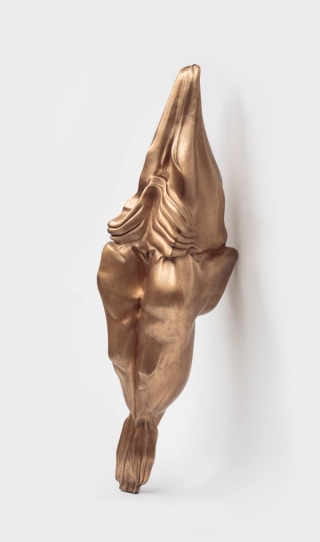
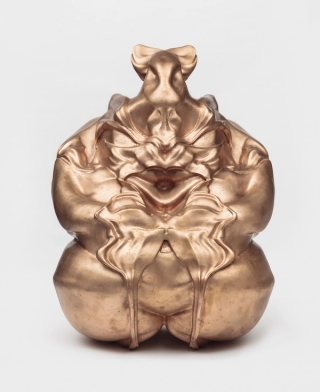
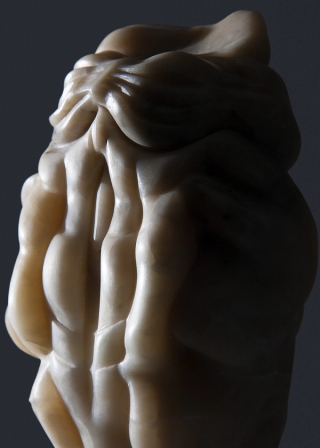
The sculptures in Birth Canal—of which “Superior Oneness” (Figure 1) and “Queen with Leopards” (Figure 2) are but two examples—are based on the small Venus figurines that archaeologists have dated back to the Paleolithic period. It might be tempting to view these works as mimetic, albeit abstracted or even distorted, representations of the female body, as per the commonly held belief that views Venus figures as “Paleolithic porn”. The fluid lines and folds of Humeau’s sculptures lend themselves to this approach, partially recalling the biomorphic works of Georgia O’Keeffe, which were famously read as representations of female genitalia. To treat the sculptures in Birth Canal in a similar fashion would not be completely unjustified since the exhibition was curated to invoke the birth canal, making visitors’ movement through the space a return to their (biological) origin (Heskes, 2018). However, to view the sculptures as no more than a play on the female form would be akin to the “Duchampian stripping” that treats the female body as an endlessly reproducible type. Doing so would also mean disregarding the recent work of American anthropologist Bethe Hagens, who argued that Paleolithic Venus figurines are visual representations of an early modern human practice of ingesting animal brains for their psychotropic effects (Heskes, 2018), as well as to perpetuate the anthropocentric assumption that “reason is not only an exclusive but also […] the essential characteristic of the human species” (Strom, 2017, 85). Significantly, Humeau herself wondered why, if Hagens’ theory is true, Paleolithic peoples would present such experiences in the guise of a body that can be codified as female, given that “brains are much more abstract” (Sherwin, n.d.).
The sculptures “Superior Oneness” and “Queen with Leopards”, as well as the other works in the exhibition, exemplify how contemporary Surrealist practices have moved away from a straightforward exploration of uncanniness, where the emphasis is placed on how disturbing realistic likeness can be. Humeau also does not appear to be particularly focused on the question of how objects are connotated as “feminine” in the way that Foster discussed, although there are certainly some elements of this at play. Rather, the works in Birth Canal exist in a transitory space, between human and animal, in which there is the discreet, underlying interest in undermining the Surrealist viewpoint that “[n]onhuman animals are precisely the corollary [to dolls and mannequins]: they are living, possibly sentient beings, and yet their form is unhuman” (Strom, 2017, 13). The uncanniness of Humeau’s sculptures lies not in the way they disrupt and expand the familiar constructs of “Woman” and “animal”, but in the way they speak to the innate marvelousness found in Nature, which Darwinian evolution sees as being driven by reason (Strom, 2017, 24). Humeau’s sculptures are not a vision of an alternative reality or a futuristic vision like something out of a work of science fiction. Instead, they propose a way of rethinking what we perceive to be the separate and distinct forms of existence.
This is not to say that Humeau has completely severed the umbilical cord with mechanization in her sculptures. Similarly, the fact that there are no literal automatons in Birth Canal does not mean that the exhibition is not interested in technology or in the possibilities that result from playfully recombiningbodies(whether human oranimal) andmachines. Humeau’s sculptures are indebted to the process of mechanization, since Humeau does not use her hands to make them. For Birth Canal, the artist “worked with a bronze foundry and a stone carving company to produce them, and the digital renderings retain a slick, machine-made appearance” (Allen, 2019). Although the process of creation makes these sculptures “mechanical,” they do not come across as such, nor are they ontologically mechanical, as Nicholas Heskes (2018) points out, “appear[ing] soft, abstract, and spectral until one gets closer and sees they are made from marble, bronze, and alabaster.” This fluid state between human and nonhuman also disrupts what Renu Bora (1997) theorizes as “TEXXTURE,” “refer[ing] not really to surface or even depth so much as to an intimately violent, pragmatic, medium, inner level […] of the stuffness of material structure” (99). Rather than classify the work as either human-female or animal, which would rupture the ambiguous state in which the sculptures exist, Humeau crafts a new identity rooted in hybridity that acknowledges and utilizes the uncertainties that arise upon seeing the work as visitors come to terms with the fact that “[t]he animal surrounds the human at both ends: it is the origin and the end of humanity” (Grosz, 2011, 12).
The triangular relationship between Woman, Nature, and automaton in Birth Canal results in the creation of a cyborg, one that, like Donna Haraway’s (1991), “is resolutely committed to partiality, irony, intimacy, and perversity. It is oppositional, utopian, and completely without innocence” (151). Drawing from all three categories, Humeau engages in a form of disassembly and reassembly that challenges the belief that there are clearly defined boundaries that separate these three forms of being. The sculptures “Superior Oneness” and “Queen with Leopards,” as well as the others in the exhibition, embody what Deleuze and Guattari (1986) describe as the process of becoming, as they are “not a correspondence between relations […nor] a resemblance, an imitation, or […] identification” (237). They are not endpoints, nor are either only human or only nonhuman. A form of “cyborg politics,” Humeau’s sculptures express the “struggle for language and […] against perfect communication” (Haraway, 1991, 176) that encourages the viewer to forego the search of kinship that is based on familiarity and instead consider how a proximity to the nonhuman results in an ontological amalgamation that changes how one perceives the human.
Animal mothers: Performing gender in nonhuman bodies
Nature has a strong presence in Humeau’s oeuvre, the sculptures in Birth Canal exemplifying a more subversive approach to the topic. Her interest in nature, however, differs from the historical (male) Surrealists, who viewed “‘nature’ [as] a watch-word for the marvelous, the instinctual beneath the civilized, and a historical cipher for uncanny primordial origins” (Roberts, 2016, 288), and is closer to the way the female Surrealists of the twentieth century employed the term. Moving away from a generalized, even infantile, view of the natural world, Surrealists like Leonora Carrington, Meret Oppenheimer, and Remedios Varo focused on more pressing and specific issues, such as the “[r]edefinition of the relation between humankind and other animals, solidarity with endangered species, [and] a nonexploitative regard for the planet we live on” (Rosemont, 1998, li). It would be an oversimplification to say that Humeau’s approach is similarly rooted in activism, although her work does lend itself to potential further discussions around issues like speciesism and the Anthropocene. Humeau’s goal is broader. Set on “hijacking these infinitudes [time, micro and macro, living beings] by creating eternal beings, and hereby also something horrific, because what I create is not a normal biological cycle” (Andersen, n.d.), her work asks viewers not only to look at the surrounding world in a new light but to go further and imagine an alternative existence capable of usurping all that we know, to challenge the existing power dynamics between the human and the non.
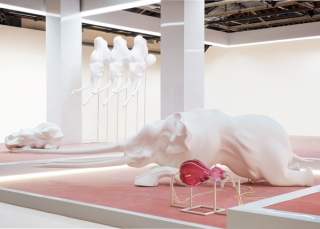
Humeau’s 2016-17 exhibition FOXP2 takes a more “formal” approach in its engagement with Nature, making it the focal point as well as the “base” to which the anthropocentric questions about gender, identity, and the body have been added. Whereas Birth Canal functions similar to the famous duck-bunny optical illusion—from a distance, the sculptures recall female genitalia, yet reading the exhibition summary reveals the hidden form of animal brains—in FOXP2 there is something akin to a false sense of comfort, a belief that one is not only looking at elephants but that the elephants will behave as elephants are supposed to. This kind of expectation causes one to forget that “[o]bjects are not just themselves—they are uncanny: they are both themselves and not-themselves” (Morton, 2013, 64). Humeau uses an approach similar to the Surrealist found objects, which were mass-produced items often purchased from flea markets and imbued with new meaning by being placed in unexpected or illogical circumstances. FOXP2 also recalls the Surrealist Exhibition of Objects that was shown at Charles Ratton’s gallery in May of 1936, where objects from disparate fields and contexts were brought together to undermine the belief that items should be rationally categorized. Viewers likely do not expect to walk in to find a room full of elephants in a variety of positions and states of being. In undermining what one expects to find inside a gallery, Humeau is simultaneously transfiguring the (art) object as well as reality.
The uncanniness in FOXP2 is delayed compared to Birth Canal, revealed only after the visitor’s focus shifts to consider the complex system of tubes and vessels standing next to each sculpture. Perhaps the uncanniest part of the exhibition, however, is hidden in plain sight: the carpet on which all the sculptures lie is created from chemicals found in the human body, such as chlorine, iron, and magnesium, deconstructed and taken over by Nature. The marvelous also takes on a new significance in FOXP2, less concerned with perpetuating the Surrealist project, which “pledged […] the reenchantment of a disenchanted world, of a capitalist society made ruthlessly rational” (Foster, 1993, 19), than with breaking down the idea that the marvelous can be crystalized within a single, physical entity that then becomes the object of admiration. Nature is not a static object-like entity in FOXP2. Instead, it is a force capable of setting the pace for transformation and subverting the common-held view that Nature is timeless and unchanging and always playing catch-up to the tune of culture (Grosz, 2005, 45). Humeau literally showcases the element of the marvelous contained within the system we currently live in, drawing on the prevailing cult of the object and the “luminous horror” of contemporary society, “a paradox coming from the intense brilliance which dazzles us and prevents us from seeing” (Lamarche-Vadel, 2016, 81). Automatization is therefore necessary in FOXP2, not to break down the sculptures and make them more exciting for visitors to look at, but to demonstrate how Nature might continue existing despite the pervasiveness of the technological.
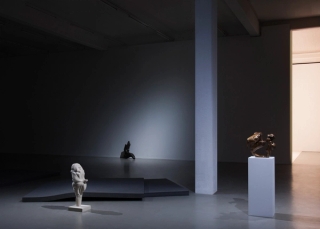
FOXP2 consists of a herd of eight elephants situated around a room in a way that invokes the industrial showroom. The sole function of their “existence” is to display a variety of feelings and sentience states they have been assigned to them by Humeau on an endless, automated loop. In the center of the herd lies “Echo, A Matriarch engineered to die” (Figure 3), arguably the focal sculpture in the exhibit. What underscores Echo’s role as a matriarch is the sense of an intimate collectivity shared by all the elephants, their close physical proximity to each other as all eight perform variations of what can be considered the funeral rites of elephants. Each elephant is accompanied by their own individual, albeit external, circulatory system that allows them to “perform” their respective state of being, containing substances like alcohol (for the drunk elephant), an aphrodisiac (for the lovers), and elephant tears (for the elephant experiencing depression) (Eastham, 2016). Humeau’s artistic decision highlights an important clarification of the notion of automatization and what it means for something to move by itself, “where the preposition by might be taken to suggest something like ‘by means of themselves,’ or through their own agency” (Connor, 2017, 19), or in this case, by means of the possibility of movement, so long as the artificial vascular system remains operational for each elephant.
What is uncanny about Humeau’s elephants is not the fact that the processes and experiences we think of as instinctive and ingrained have been automated, but that we are witnessing the nonhuman body experiencing what we sometimes think are uniquely human feelings in an intimate collective experience. Each of the eight elephants has been engineered to perform natural cycles—whether these are emotionally-based, like falling in love or feeling sad, to the bookends of all lifecycles: to be born and to die—in a consistent, timed look. This predetermined and limited form of existence recalls Descartes’ argument that “animals are automata like machines that merely react to stimuli but do not have any true responses” and that “because they don’t have language, they don’t have souls” (Oliver, 2009, 26). However, the fact that these cycles were designed to allow the elephant sculptures to participate in a funerary ritual, an inherently emotionally complex event, reminds us that the real animals can engage in a similar form of sentimentality as humans. While their machine counterparts can be programmed to go through the motions of such rituals, there is still a power and recognition contained in the unmistakable form of (mechanical) mourning. The second source of uncanniness in FOXP2 is thus the moment when the human ego is offset by the realization that the nonhuman Other lacks much of the otherness conventionally ascribed to them. By seeing a mechanized animal emote in familiar way that invokes the deeply personal and seemingly “uniquely human” way of responding to overwhelming emotional circumstances, Humeau further breaks down the barrier between the human and the nonhuman. Through her sculptures, she demonstrates that a shared kinship is possible, the fact that they were programmed based on information Humeau received from scientists only heightening how little the public still knows about shared forms of emotional labour and release.
Echo’s body, which has been codified as female by Humeau without being visually identifiable as such, operates as a text that recalls Elizabeth Grosz’s (1995) question: “Is there a distinctively feminist or feminine set of objects, contents, in feminist texts?” (14). How do we read the nonhuman body as “female” and how do we expect this body to look and act? For some, the instinctive answer might be rooted in biological sex, yet doing so results in the perpetuation of the Essentialist point of view as it suggests that not only is there a “fixed essence of women” that is “shared in common by all women at all times” (Grosz, 1995, 47), but that this very same faulty statement can then be applied to the nonhuman body as well. Moreover, such an approach falls into the same trap that Judith Butler (1988) famously referred to when she wrote that “[g]ender is not passively inscribed on the body, and neither is it determined by nature, language, the symbolic, or the overwhelming history of patriarchy”(531). Deleuze and Guattari (1986) come the closest to providing a satisfactory solution to the situation, proposing that Becoming-woman is not imitating this [molar] entity or even transforming oneself into it […] not imitating or assuming the female form, but emitting particles that enter the relation of movement and rest, or the zone of proximity, of a microfemininity. (275)
“Echo” is a symbol of potential, of the evolution of gender beyond the familiar boundaries of what we currently believe we know, for to try drawing a parallel between a human matriarch and the elephant matriarch means assuming that a perfect equivalence can be found between them.
To treat “Echo” as merely the animal version of a human matriarch would mean that the sculpture is then read as an anthropomorphization. To some extent this approach is built into the premise of the exhibition—Humeau provides visitors with a glimpse of what nonhuman creatures like elephants might achieve if they were on equal footing with us when it comes to their vocal capabilities and the development of their consciousness. Rather than reiterating the long-held view that animals, and nonhumans more broadly, are lesser than humans, FOXP2 engages in a form of speculative futurism and alternative history by emphasizing the role of coincidence in the evolutionary process and without reiterating the belief in humanity’s “manifest destiny” as superior beings. Before dismissing anthropomorphism as a form of diminishment and a tactic of oppression, it is helpful to remember the words of Jane Bennett (2010): “We need to cultivate a bit of anthropomorphism — the idea that human agency has some echoes in nonhuman nature — to counter the narcissism of humans in charge of the world” (49). Humeau’s sculptures are not direct forms of anthropomorphism since the elephants do not behave as humans and “perform,” in a variation of Butler’s argument, acts we consider “human,” like speaking of wearing clothing (1988, 526). In fact, anthropomorphism is what make Humeau’s imagining of a potential future in which speech capabilities occurred in a nonhuman species not only possible but also successful. “Echo” and the other elephants invite viewers to consider why it feels strange or even uncomfortable to witness another species potentially catching up to us, to dwell on that sensation of being “left behind.” More importantly, the sculptures highlight our collective “reluctan[ce] to understand the animal world as cultural” (Grosz, 2005, 49).
If we continue to view the nonhuman the way Jean-Francois Lyotard’s (1991) fictional speaker does when he inform the reader that “no doubt they [the Other] do have a soul, but of a type different from ours, speak a language, but a bodily language (even their words are like things), they hear someone, but not us” (130), then we will continue to perpetuate the treatment of the animal body in the same way that the historical Surrealists treated the female body: as a muse, a source of creative, egoistical potential. Like the automaton, the female body was fetishized and imagines as a series of objects that could be rearranged at the will of the (male) artist, as the earlier example of Hans Bellmer’s poupeé demonstrate. Like the automaton, the female body was consequently viewed as subhuman and, therefore, not alive. With the sculptures in FOXP2, Humeau challenges viewers to expand the boundaries of what they perceive to be real without Othering or undermining the agency of the unfamiliar body, ensuring that empathy, rather than fear or repulsion, be the first response.
The relationship between Woman, Nature, and the automaton is more apparent in FOXP2 than in Birth Canal. However, that does not mean that questions of gender can be imposed onto the nonhuman body like Echo’s in a straightforward manner, as this would mean disregarding the fact that gender is performed and that our complex understanding of it, in that way that theorists like Butler have discussed, is still limited to the human experience. It would also mean dismissing the difference between gender, which exists as a spectrum, and sex, which is presented as binary based on the division along biological lines. Similarly, Humeau highlights the artificiality of the concept of Nature in her work, recalling Morton’s (2013) observation that ““[s]pace” and “environment” are ways in which objects sensually relate to the other objects in their vicinity […which] humans have called […] Nature” (43). In FOXP2, Humeau creates an automated existence that lies somewhere between the hysterical Woman and the nonsentient machine, with the express goal of reaffirming the fact that “[a]nimals are not complex machines but living forms, whose bodies are not randomly produced but are specifically “tuned” to coordinate with their milieu, with the melody with which they must coordinate or harmonize” (Grosz, 2011,177). Humeau’s use of mechanization, then, is merely a form of metaphor, a way of facilitating a conversation about gender and the ways in which the nonhuman existence can mirror or even surpass the humans.
Speaking oneself into existence: The voice as agency
In discussing the triangular relationship between Woman, Nature, and automation in Humeau’s work, it would be an oversight to focus solely on the physical sculptures, especially since both Birth Canal and FOXP2 feature an auditory component. Humeau’s use of sound is arguably the most significant way in which the artist diverges from the Surrealists and their legacy. The sculptures never speak directly and therefore do not reinforce their ego as a means of consolidating their presence, as discussed earlier regarding the thin boundary between nonhuman self-determination and anthropomorphization. Nonetheless, the sound pieces in both exhibitions consider the way voice is a form of identity and give Humeau’s sculptures some semblance of agency. Humeau does not speak for her works in the way that the Surrealists did, which viewed that which was not the heterosexual male as a creative essence that was there for the taking and claiming. Instead, she draws on the fact that sound is a way of making oneself known and marking one’s presence to work against the idea that silence is a convenient excuse to disregard the uncanny Other and write it off as nonexistent.
Once again, Hoffmann’s Olimpia functions as a precedent for the way the voice can help the nonhuman assert their presence. Even though her existence is indebted to the hand of a human, the fact that Olimpia has been given a voice should not be overlooked, as it is her voice, rather than the physical human likeness, that is perhaps the greatest source of her uncanniness. Sounds that resemble speech are an indication of a lifeform that can stake a claim to intelligent sentience and that is trying to find a way of expressing the “hieroglyphics from an inner world filled wit love and higher knowledge of the spiritual life, which exists in contemplation of the eternal beyond” (Hoffmann, 2014, 59), whether by using a language that has been accepted by a certain part of the population or by trying to craft their own. As with the argument of the Cartesian subject regarding the cyclical existence of the elephants in FOXP2, one can say that the fact that the sound pieces are pre-recorded and similarly played on a loop means that the sculptures are also not truly “speaking”. Jacques Derrida (2008) considers this question of the animal, or more broadly the nonhuman, response in The Animal That Therefore I Am and distinguishes between “response” and “reaction,” arguing that animals like bees “merely obey a fixed program, whereas the human subject responds to the other, to the question from or of the other” (123). Earlier in the text, he notes that “the question of the animal response has as its stakes the letter, the literality of a word” (2008, 8), which is particularly relevant in FOXP2, where the possibility of alternative speech is the focal question. Posthumanist theorists like N. Katherine Hayles (1999) strive to move past this notion of response vs reaction, recording vs original speech. Instead of seeking validity in human responses that affirm our conscious minds against the animal’s uncritical machine nature, Hayles argues that “in the posthuman view […] conscious agency has never been in control” (1999, 288). The question of the echo against the true voice only remains “if one thinks of the subject as an autonomous self independent of the environment” (Hayles, 1999, 290). An echo, whether a programmed mechanical one or the response of an animal, is not solely an extension of its human counterpart. Like the Surrealist object, it is capable to acquiring new meaning and come to its own to form a new state of transfigured being because of its journey through different contexts.
As a result, there is a difference between reproducing a body and reproducing a voice. The voice does not undergo the same direct process of copying as the body due to the voice’s omniscient quality. According to Philip Brophy (2010), what is lost in the process of reproducing the voice is also the one thing that makes the voice human: breath (362). Such an argument, however, suggests that the nonhuman body cannot be acknowledged as equal to the human because it implies that breath is distinctly human in a way that an elephant’s breathing cannot be. Humeau was notably conscious of her work’s stake in the real, especially in FOXP2, insisting the accompanying sound piece “sound[ ] artificial” so that it “could not be ‘mistaken for truth’” (Eastham, 2016), something that, according to Brophy, should not have been a concern at all, due to the speculative nature of the piece and because the technological voice cannot reproduce breath and is therefore inhuman. Humeau’s use of the voice is strategic, subverting the association between women and hysteria (Breton, 1972, 179-180) as well as between animals and automatons (Strom, 2017, 85). Just as Humeau images alternative forms of being by combining familiar forms to create physical hybrids, so does her use of sound function as a means for theorizing a radically different form of communication and consciousness that we might otherwise struggle to comprehend without having a partially familiar point of reference in place.
Of the two exhibitions, Birth Canal is the most unsettling, in part because the sound piece “The Venuses envision the extinction of their offspring, humankind” (2018) consists of “an alien language made up of whines, shrieks, gibbers, and laughing, which are impossible to understand literally” (Heskes, 2018). The sound piece also operates in tandem with the “scent piece” “Birth Canal (Venus body odour), The scent of the birth of humankind” (2018), which mimics the smell of human birth. In combination, the two works likely assail the senses, tapping into the kind of raw reality that interested the Surrealists while challenging the perceived limits of our own human bodies, a task that the material hybridity and fluid forms of the physical sculptures continues as soon as the viewer enters the main gallery space. By having the voices “speak” simultaneously, as a collective, “The Venuses envision the extinction of their offspring, humankind” denies visitors the ease of establishing a clear linear correlation between the voice and its source. This means that the voice cannot be limited to the physical body and, more importantly, that the Cartesian and Derridian assumptions about sentience and consciousness are subverted because the visitor is not given the satisfaction of making assumptions. The voice is able to maintain its “omnipotent charismatic character” (Dolar, 2006, 67) without becoming banal and visitors can focus on the speech-act itself, on the way the invisible presence permeates the space and haunts it like a specter, a form of “habitation without proper inhabiting […] a haunting” (Derrida, 2006, 21).
A similar situation unfolds in FOXP2. Visitors begin their experience by walking through a dark passageway, where they hear “a chorus of inchoate but recognizably humanoid whoops and hollers” (Eastham, 2016) sung by “a choir of 108 billion Homo sapiens who have lived since the dawn of humanity, thus guiding the elephants on their ascension towards consciousness” (Marguerite Humeau: FOXP2, 2016, 6). These voices do not speak for the elephant sculptures in the next room but serve almost as a form of protection for the sculptures by preventing them from being interpreted as merely uncanny, fetishistic objects, especially since the format of the showroom easily lends itself to such an approach. As with Birth Canal, FOXP2 leaves the visitor contemplating the source of the voices physically and metaphorically. The fact that both exhibitions revolve around the disappearance of mankind also forces visitors to reconcile with the nonhuman’s presence in our lives, as well as to consider the potential—for development and further evolution but also for alternative forms of knowledge, communication, and kinship—the nonhuman carries that human society has consistently ignored.
The sound pieces in the two exhibitions are, in some ways, an extension of the Surrealist tradition of automatic writing that has simply been transposed onto another medium, creating an additional layer of fluidity that helps contextualize the sculptures without rigidly defining them. There is no need to know for certain who or what we are hearing; it is sufficient to acknowledge that we hear, hence that form of life exists, a variation of cogito ergo sum that is based on the fact that “[t]he voice — through the multiplicity of its invisibility — will always locate itself in adverse directions beyond the origin of its generation and production” (Brophy, 2010, 361). In fact, it is by not knowing that sound’s full power can come into effect. The uncanniness lends itself to Humeau’s creation of alternative realities in the form of immersive artistic ecosystems that recall the Surrealist environments displayed in the 1938 International Surrealist Exhibition in Paris and reflect the more-than-human world through a combination of fact and fantasy.
Conclusion
Humeau’s works establish a triangular relationship between Woman, Nature, and the automaton that did not exist to the same extent in the work of the twentieth-century Surrealists, who approached automation more literally and used the female body and “romantic ruins” as categorical terms for accessing the subconscious and an expanded reality. The artworks from Birth Canal and FOXP2 examined in this paper point to a redefinition of automation, or what we might think of more broadly as technology today. Although we encounter the familiar interest in the artificially lifelike in FOXP2, automation should be understood as a strategy employed by Humeau to highlight the shared process of Othering that Surrealists subjected human female and nonhuman bodies to. Moreover, the question of gender that has been raised in this paper should not be treated as an argument for a return to the neo-Romantic idea of indisputable link between Woman and Nature, since Birth Canal and FOXP2 establish Nature as a foundation that all types of being, even mechanical ones, can trace their roots back to. If Humeau’s work is to be discussed in terms of its treatment of and stance on humanity or “humanness,” then emphasis should be placed on asking why it is so tempting to impose anthropocentric constructs like gender onto nonhuman bodies and why this is still considered to be a vital step before the nonhuman is acknowledged or treated as our equal. With these two exhibitions, Humeau opens a new chapter in the Surrealist movement, in which the battle against the Olimpias has ended and the struggle to sever the perceived connection between the nonhuman and a non-sentient object-like existence has begun.
References
Marguerite Humeau: FOXP2: Palais de Tokyo 23.06-11.09 2016, 15.10 2016-08.01 2017. (2016). Nottingham Contemporary.
Allen, Jane I. (April 23, 2019). Marguerite Humeau. Sculpture Magazine.https://sculpturemagazine. art/marguerite-humeau/.
Andersen, Karen V. (n.d.). Looking past the future: An interview with Marguerite Humeau. Seismopolite: Journal of art and politics. https://www.seismopolite.com/looking-past-the-future-an-interview-with-marguerite-humeau.
Bennett,J (2010).Vibrant matter: A political ecology of things. Duke University Press.
Bora, R. (1997). Outing texture. In E. K. Sedgwick (Ed.), Novel gazing: Queer readings in fiction (pp. 94-127). Duke University Press.
Breton,A.(1972). Manifestoes of surrealism (R.Seaver & H.R.Lane,Trans.) University of Michigan Press. (Original work published 1924 and 1930).
Brophy, P (2010). Vocalizing the posthuman. In N.Neumark, R.Gibson & T.vanLeeuwen (Eds.),
Voice: Vocal aesthetics in digital arts and media (pp.361-82).MITPress.
Butler, J. (1988). Performative acts and gender constitution: An essay in phenomenology and feminist theory. Theatre journal 40(4), 519-531.
Conley, K. (1996). Automatic women: The representation of woman in surrealism. University of Nebraska Press. Connor, S. (2017). Dream machines. Open Humanities Press.
Deleuze, G. & Felix G. (1986). A thousand plateaus: Capitalism and schizophrenia (B. Massumi, Trans.) University of Minnesota Press.(Original work published 1980).
Derrida, J. (2006). Specters of Marx: The state of the debt, the work of mourning, and the new international (P. Kamuf, Trans.). Routledge. (Original work published 1993).
Derrida, J. (2008). The animal that therefore I am (Marie-Luise Mallet, Ed.). Fordham University Press. Dolar, M. (2006). A voice and nothing more. MIT Press.
Duchamp, M. (1989). The writings of Marcel Duchamp (M. Sanouillet & E. Peterson, Eds.). Da Capo Press. Eastham,B.(October19,2016).Mysteries&methodologies.Frieze.https://frieze.com/article/mysteries-methodologies.
Foster, H.(1993).CompulsiveBeauty.MITPress.
Gendolla, P. (2007). Impossible people: Some thoughts on the cultural history of the android. In C. Lischka & A.Sick(Eds.), Machines as agency: Artistic perspectives(pp.88-101). Transcript.
Grosz, Elizabeth A.(1995).Space, time and perversion:Essays on the politics of bodies. Routledge.
Grosz, Elizabeth A(2005).The nature of culture. In Time travels: Feminism, nature, power (pp.43-52).
Allen & Unwin.
Grosz, Elizabeth A. (2011). Becoming undone: Darwinian reflections on life, politics, and art. Duke UniversityPress.
Hayles, N. K. (1999). How we became posthuman: Virtual bodies in cybernetics, literature, and informatics. The University of Chicago Press.
Haraway, D. J. (1991) A Cyborg manifesto: Science, technology, and socialist-feminism in the late twentieth century. In Simians, cyborgs, and women: The reinvention of nature (pp.149-191). Routledge.
Heskes, N.(December20, 2018). Marguerite Humeau: Birth Canal. The Brooklyn Rail. https://brooklynrail.org/2018/12/artseen/Marguerite-HumeauBirth-Canal.
Hoffmann, E.T.A. (2014). The Sandman (C. Moncrieff, Trans.). Alma Books Ltd. (Original work published 1816).
Lamarche-Vadel, R. (2016) Who Knows. In Marguerite Humeau: FOXP2: Palais De Tokyo 23.06-11.092016, Nottingham Contemporary 15.10 2016-08.01 2017 (pp. 77-82). Nottingham Contemporary.
Lyotard, J-F. (1991). Speech snapshot. In The inhuman: Reflections on time (G. Bennington & R. Bowlby, Trans)(pp.129-134).StanfordUniversityPress.
Oliver,K. (2009). Animal lessons: How they teach us to be human. Columbia University Press. Morton, T. (2013). Realist Magic: Objects, Ontology, Causality. Open Humanities Press.
Morton,T. (2017).Humankind: Solidarity with non-human people. Verso.
Roberts, D. (2016). Surrealism and natural history: Nature and the marvelous in Breton and Caillois. In D. Hopkins (Ed.), A Companion to dada and surrealism (pp.287-303).
John Wiley & Sons, Ltd. Rosemont, P. (1998). Introduction: All my names know your leap: Surrealist women and their challenge. In P. Rosemond (Ed.), Surrealist women: An international anthology (pp. xxix-lvii). University of Texas Press.
Sherwin, S. (n.d.) Artist marguerite humeau reinvents the past to create the future. Art | Basel. https://www.artbasel.com/news/marguerite-humeau-art-basel-miami-beach-clearing-skye-sherwin.
Strom, Kirsten.(2017).The animal surreal: The role of Darwin, animals, and evolution in surrealism. Routledge.
Suechun Cheng, J., & Richardson, M. (2016). The marvellous. In K. Fijalkowski & M. Richardson (Eds.), Surrealism: Key concepts (pp. 239-247). Routledge.