Marguerite Humeau: Venuses, Turtles and other Hand-Held Cosmic Models
Charlotte-Marie Carrier
From Espace art actuel, No.122, Montréal, CA, 2019
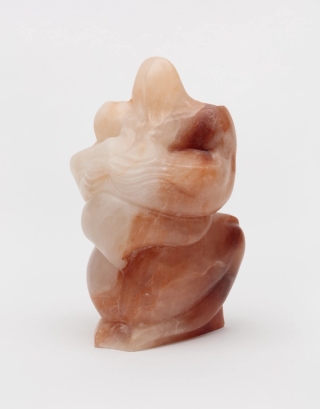
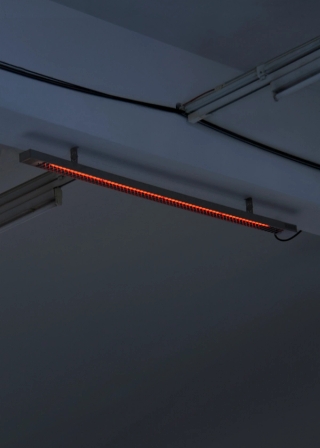
Entering Marguerite Humeau’s ECSTASIES at the Kunstverein in Hamburg evokes a journey through the abyss of a mystical cave. Echoes of distant groans and whispered chants interrupt the muted atmosphere of the gallery space, while delicate rays of light illuminate bronze and translucent alabaster sculptures.
Humeau’s exhibition, an edited version of her September 2018 solo show at the New Museum in New York, presents a tribe of totemic sculptures along with hypnotising sound pieces and a series of wildly annotated drawings and sketches. For her largest institutional solo exhibition in Germany to date, she opted for small-scale sculptural works inspired by her extensive study of Paleolithic Venus figurines. Such figurines were produced over 26,000 years ago across Europe and Asia. They were carved in various forms of stone, bone, ivory, or clay, and are considered one of the earliest known forms of art. While the function of the Venuses remains unknown, archaeologists and historians suggest that they could have been viewed as religious figures, erotic art or fertility goddesses. Humeau’s exhibition explores the speculative theories surrounding the origins of these artefacts and humankind itself. Her fine-tuned archaeological approach to art making has driven her to map out a hypothetical journey of the origins of consciousness, art and religion, proposing a new historical perspective in which myth-making, science, esotericism and eroticism intertwine.
Inspiration for ECSTASIES comes primarily from American anthropologist Bethe Hagens’ article Venuses, Turtles and other Hand-Held Cosmic Models in which she points to the similarities between the shape of Venus figurines and different types of animal brains. Published in the 90s, this theory enabled Hagens to defy mainstream historical beliefs and envision a less gendered origin story for the Venuses. Of particular interest to her were evolutionary theories that linked the use of psychedelic substances to the development of human intelligence.
Such theories were established when ethnobotanist and psychedelics activist Terence McKenna published his book Food of the Gods.
McKenna argued that what enabled Homo erectus to evolve into Homo sapiens was its ingestion of magic mushrooms. While it is now widely accepted that Cro-Magnon man may have encountered several types of plant-based psychedelics, Hagens was interested in the psychoactive properties available in the flesh of certain animals rather than in the vegetal. Drawing parallels between the morphology of Venus figurines and various types of animal brains, she theorised that Paleolithic shamans may have eaten brains as part of spiritual rituals. According to her, the belief that recipients would gain some of an animal’s abilities, and that mixing different brains could lead to the development of hybrid powers may have influenced the ritual of animal brain consumption. For Hagens, the Venuses were carved replicas of brain concoctions, which embodied hidden recipes to reach spiritual ecstasy.
Marguerite Humeau’s exhibition elaborates on Hagens’ theories, staging the speculated historical moment at which humans came across psychoactive substances for the first time. What could have unfolded from this encounter remains hypothetical yet, for the artist, this speculation allows for a re-imagination of possible histories and futures. Her sculptures, drawings and soundtrack re-enact this prehistoric quest for spiritual and metaphysical ecstasy.
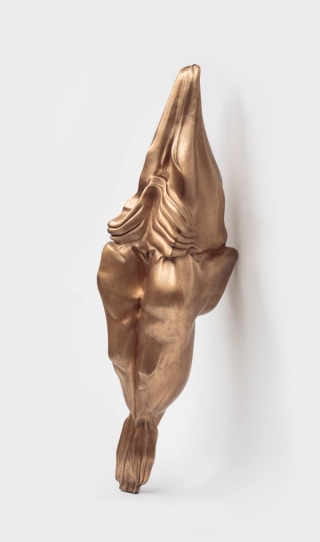
In the darkened exhibition space, we discover sculptures that differ from Humeau’s previous biomorphic white resin installations. These works are earthbound and heavy, resembling oversized labia, intertwined bodies and exposed brains. Though they may appear futuristic, they are skilfully cast using traditional materials. Their soft-edges and rounded forms evoke the female shapes of the Venuses, while remaining alien and ambiguous. The first work in the exhibition, Superior Oneness, A 70-year-old female human has ingested an alligator’s brain (2018), vaguely alludes to the shape of a Paleolithic Venus. The bronze rather suggests the slender skull of an alligator or stretched genitalia in transformation. Deceptively symmetrical, the form seems to have been caught in mutation. A second work, Venus of Kostenki, A 35-year-old female human has ingested a marmoset’s brain (2018), evokes the eponymous Siberian Paleolithic Venus. Dating from 25,000-20,000 BCE, the original artefact unmistakably suggests a female form. However in Humeau’s interpretation, the body is somehow distorted, melting into itself. Mounted on plinths or standing directly on the gallery floor, only flickering dimmed lights illuminate the works. They stand proudly like shrines dedicated to numinous deities, surrounded by a series foam mattress dispersed across the gallery’s floor. As we lay down on the soft beds, the atmospheric sound pieces start to entrance us. They are inescapable: urgent breathing, spasms, uncanny sounds and slow groans that evoke the climaxing of hybrid creatures. Through these mesmerising chants, we follow the Venuses as they push the limits of their brains’ capabilities and reach ecstasy through intoxication. Halfway between human and animal, Humeau’s imagined spirits embark on a psychic journey to rewind the course of history and speculate on possible futures for humankind.
In the exhibition’s second room, the artist presents monochromatic drawings and sketches that follow a logical, though indecipherable, notation system. The fruit of her discussions with experts such as shamans, psychedelic drug researchers and neuroscientists, this new series underscores Humeau’s desire to inscribe a speculated primordial expansion of consciousness, body and soul into broader temporal considerations. The inquiry’s spectrum is substantial; some drawings represent elaborated maps of the flows taking place within in-trancebrains, while others list what Humeau calls Extinct Spiritual Technologies.
The series bridges prehistoric past and distant futures, charting the evolution of consciousness across time and space. In many ways, ECSTASIES confronts the brevity of human existence with the incomprehensible vastness of geological and cosmological time.
In line with a contemporary impulse to investigate the past in order to better understand the present, Marguerite Humeau’s work re-configures narratives surrounding archaeology, consciousness, bodies and neurones.
Marie-Charlotte Carrier is a London-based curator and writer whose research focuses on art practices that deconstruct the networks of transnational ecosystems, where individuals, groups and machines cohabit. She has worked at the Zabludowicz Collection, London, The Art Gallery of Ontario, Toronto and Arsenal Contemporary Art Montréal. And she has acted as an invited curator for Festival Art Souterrain and Galerie AVE in Montreal. She currently works as an assistant curator at the Barbican Centre (London).